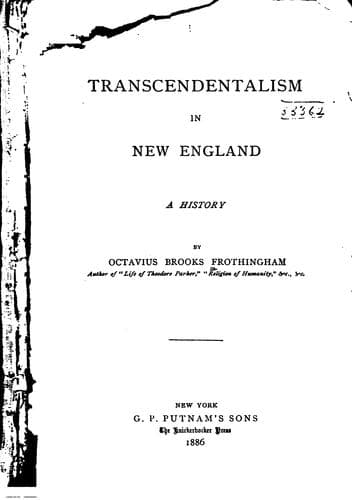
Transcendentalism in New England: A HistoryFrothingham, Octavius Brooks
Philosophy
Transcendentalism in New England: A History
Frothingham, Octavius Brooks
Transcendentalism (New England)
The Transcendentalist was satisfied with nothing so long as it did not
correspond to the ideal in the enlightened soul; and in the soul
recognized the power to make all things new. Nothing will content him
short of the absolute right, the eternally true, the unconditioned
excellence. He prays for the kingdom of Heaven, lives in expectation of
it; would not be surprised at its coming any day. For though the
distance is immense between the world as it is and his vision of the
world as it should be--a distance that the Evolutionist despairs of
seeing traversed in thousands of years, if he believes it will be
traversed at all,--still, as the power of regeneration is supposed to be
in the soul itself, which is possessed of infinite capacities and is
open continually to inspirations from the world of soul, the
transformation may begin when least expected, and may be completed
before preparation for it can be made. Hence his boundless enthusiasm
and hope; hence the order of his feeling, the glow of his language.
Hence his disposition to exaggerate the force of tendencies that point
in his direction; to take the brightest view of events, and put the
happiest construction on the signs of the times. In the anti-slavery
period the Transcendentalist glorified the negro beyond all warrant of
fact, seeing in him an imprisoned soul struggling to be free. The same
soul he sees in woman oppressed by limitations; the same in the
drunkard, the gambler, the libertine. His eye is ever fixed on the
future.
VIII.
RELIGION.
It was by no accident that the transcendental philosophy addressed
itself at once to the questions of religion. It did so at the beginning,
in Germany, and later, in England, and did so from the nature of the
case. Its very name implied that it maintained the existence of ideas in
the mind which transcended sensible experience. Such ideas fall within
the domain of religion; ideas of the infinite, the eternal, the
absolute; and the significance and import of these ideas exercised the
minds of transcendental thinkers, according to their genius. Kant felt
it necessary to reopen the problem of God and immortality; Fichte
followed, Schelling and Hegel moved on the same plane.
Public-domain text, read in full here on John Shaqi.
Reviews
Reviews
No reviews yet
Be the first to share your thoughts on this work.
Elsewhere in the archive
Join the Discussion
Join the discussion
Sign in to leave a comment or review.
Sign InorCreate an account