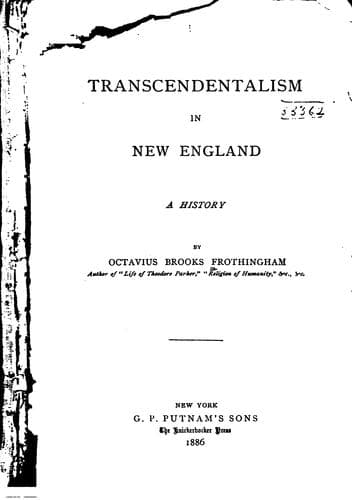
Transcendentalism in New England: A HistoryFrothingham, Octavius Brooks
Philosophy
Transcendentalism in New England: A History
Frothingham, Octavius Brooks
Transcendentalism (New England)
In Germany the philosophy of Bacon and Locke did not strike deep root.
The day of Germany was to come later. Her thoughts were pent up in her
own breast. She was isolated, and almost speechless. Her genius awoke
with the new philosophy. Under the influence of idealism it bloomed in
the richest of modern literatures. Her very skepticism, the much
talked-of rationalism, had an ideal origin. Strauss was a disciple of
Hegel. Bauer, and the "historical school" of Tübingen worked out their
problem of New Testament criticism from the Hegelian idea, the
constructive force whereof was so powerful, that the negations lost
their negative character, and showed primarily as affirmations of
reason. By being adopted into the line of intellectual development of
mankind, Christianity, though dethroned and disenchanted, was dignified
as a supreme moment in the autobiography of God.
Frederick the Great, in the middle of the eighteenth century, attracted
literary celebrities to his court, and gave an impulse, so far, to the
German mind; but the French genius found more encouragement there than
the German, and in his time French genius was speeding fast in the way
of skepticism. Condillac, Cabanis, d'Holbach, Helvetius, were of that
generation. The "Encyclopædists," the most brilliant men and women of
the generation, were planning their work of demolition. Voltaire was the
great name in contemporary literature. The books of Volney were popular
towards the end of the century. Skepticism and materialism had the
floor. It was fashionable to ridicule the belief in personal
immortality, and in enlightened circles to deny the existence of God.
The doctrines of Christianity were abandoned to priests and women;
philosophers deemed them too absurd to be argued against. Had the
assault been less witty and more scientific, less acrimonious and more
reasonable, less scornful and more consistent, its apparent success
might have been permanent. As it was, a change of mood occurred; a
conservative spirit succeeded the destructive; order prevailed over
anarchy; and the Catholic church, which had only been temporarily thrust
aside--not fatally wounded, not by any means disposed of--regained its
suspended power.
Public-domain text, read in full here on John Shaqi.
Reviews
Reviews
No reviews yet
Be the first to share your thoughts on this work.
Elsewhere in the archive
Join the Discussion
Join the discussion
Sign in to leave a comment or review.
Sign InorCreate an account