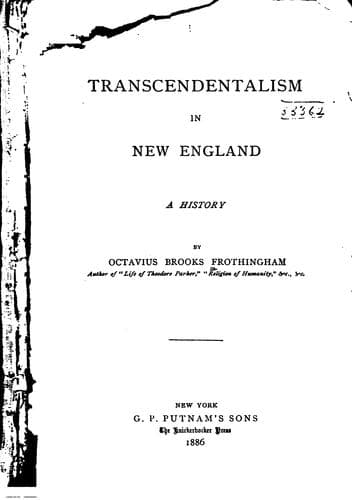
Transcendentalism in New England: A HistoryFrothingham, Octavius Brooks
Philosophy
Transcendentalism in New England: A History
Frothingham, Octavius Brooks
Transcendentalism (New England)
But rational or intellectual Christianity--in other words the system of
Protestantism, in whatever form held--received a severe blow in France
from these audacious hands. Religion took refuge in institutions and
ceremonial forms; and there remained little else except a kernel of
sentiment in a thin shell of tradition. What beliefs were entertained
were accepted on authority; reason sought other fields of exercise,
scientific, philosophical, literary; and a chill of indifference crept
over the once religious world. From France, opinions adverse to
Christianity were brought to America by travelled or curious people;
they pervaded the creative minds of our earliest epoch, and penetrated
far into the popular intelligence. The habit of thinking independently
of authority and tradition became confirmed, and as a matter of course
led to doubts and denials; for thinking was done in a temper of
defiance, which constrained the thought to obey the wish. Such
philosophical ideas as there were, came from France and England. Paley's
was the last word in morals; the "Bridgewater Treatises" were the
received oracles in religion; the rules of practical judgment had
usurped the dominion of faith.
What pass things had come to in New England, in the centre of its
culture, has been described in a previous chapter. It was time for a
reaction to set in; and it came in the form of Transcendentalism. The
"sensational" philosophy, it was contended, could not supply a basis for
faith. Its first principle was "_Nihil in intellectu quod non prius in
sensu_." "There is nothing in the intellect that was not first in the
senses." From this principle nothing but skepticism could proceed. How,
for instance, asks the Transcendentalist, can the sensational philosophy
of Locke and his disciples give us anything approaching to a certainty
of the existence of God? The senses furnish no evidence of it. God is
not an object of sensation. He is not seen, felt, heard, tasted or
smelt. The objects of sense are material, local, incidental; God is
immaterial, universal, eternal. The objects of sense are finite; but a
finite God is no God; for God is infinite. Is it said that by men of
old, bible men, God was seen, heard, clasped in human arms? The reply
is, that whatever Being was so apparent and tangible, could not have
been God. To the assertion that the Being announced himself as God,--the
infinite, the eternal God,--the challenge straightway is given: To whom
did he say it? How can it be proved that he said it? Is the record of
his saying it authentic? Might not the Being have made a false
statement? Can we be certain there was no mental hallucination? Suppose
these and other doubts of a similar character dispelled, still, hearing
is not knowing. All we have is a tradition of God, a legend, a rumor, a
dim reminiscence, that passes like a shadow across men's minds. The
appeal to miracle is set aside by historical skepticism. The wonder
Public-domain text, read in full here on John Shaqi.
Reviews
Reviews
No reviews yet
Be the first to share your thoughts on this work.
Elsewhere in the archive
Join the Discussion
Join the discussion
Sign in to leave a comment or review.
Sign InorCreate an account