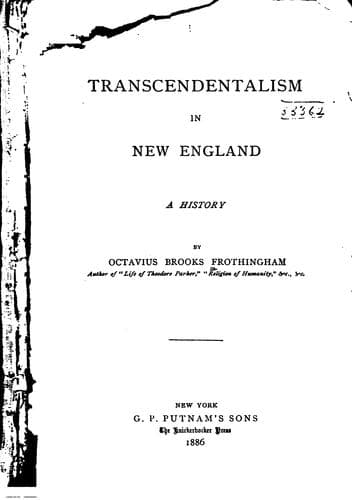
Transcendentalism in New England: A HistoryFrothingham, Octavius Brooks
Philosophy
Transcendentalism in New England: A History
Frothingham, Octavius Brooks
Transcendentalism (New England)
The other cardinal doctrine of religion--the immortality of the
soul,--Transcendentalism was proud of having rescued from death in the
same way. The philosophy of sensation could give no assurance of
personal immortality. Here, too, its fundamental axiom, "_Nihil in
intellectu quod non prius in sensu_," was discouraging to belief. For
immortality is not demonstrable to the senses. Experience affords no
basis for conviction, and knowledge cannot on any pretext be claimed.
The sensational school was divided into two parties. The first party
confessed that the immortality of the soul was a thing not only
unprovable, but a thing easily disproved, a thing improbable, and, to a
clear mind, impossible to believe. The soul being a product of
organization, at all events fatally implicated in organization,
conditioned by it in all respects, must perish with organization, as the
flower perishes with the stem. Of a spirit distinct from body there is,
according to this school, no evidence, either before death or after.
Man's prospect, therefore, is bounded by this life. Dreamers may have
visions of another; mourners may sigh for another; ardent natures may
hope for another; but to believe in another is, to the rational mind,
according to this philosophy, impossible. The sentence "dust thou art,
and to dust thou shalt return," may seem a hard one; but as it cannot be
reversed or modified, it must be accepted with submission; and in
default of another life, the honest man will make the most of the life
he has; not necessarily saying with the sensualist: "Let us eat and
drink, for to-morrow we die;" but with the hero reminding himself that
he must "Work while it is day, for the night cometh in which no man can
work." The modern disciples of this doctrine of annihilation speak in a
tone of lofty courage of their destiny, and disguise under shining and
many-colored garments of anticipation, the fact of their personal
cessation. The thinkers find refuge in the intellectual problems of the
present; the workers pile up monuments that shall endure when they are
gone; poets like George Eliot, make grand music on the harp-strings of
the common humanity; but the fact remains that the philosophy of
experience abandons, or did before the advent of spiritualism--the
expectation of an existence after death.
Public-domain text, read in full here on John Shaqi.
Reviews
Reviews
No reviews yet
Be the first to share your thoughts on this work.
Elsewhere in the archive
Join the Discussion
Join the discussion
Sign in to leave a comment or review.
Sign InorCreate an account