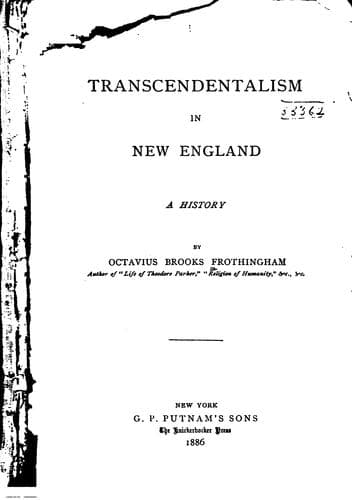
Transcendentalism in New England: A HistoryFrothingham, Octavius Brooks
Philosophy
Transcendentalism in New England: A History
Frothingham, Octavius Brooks
Transcendentalism (New England)
The Transcendentalist spoke of God with authority. His God was not
possible, but real; not probable, but certain. In his high confidence he
had small respect for the labored reasonings of "Natural Religion;" the
argument from design, so carefully elaborated by Paley, Brougham and the
writers of the "Bridgewater Treatises," was interesting and useful as
far as it went, but was remanded to an inferior place. The demonstration
from miracle was dismissed with feelings bordering on contempt, as
illogical and childish.
Taking his faith with him into the world of nature and of human life,
the Transcendentalist, sure of the divine wisdom and love, found
everywhere joy for mourning and beauty for ashes. Passing through the
valley of Baca, he saw springs bubbling up from the sand, and making
pools for thirsty souls. Wherever he came, garments of heaviness were
dropped and robes of praise put on. Evil was but the prophecy of good,
wrong the servant of right, pain the precursor of peace, sorrow the
minister to joy. He would acknowledge no exception to the rule of an
absolute justice and an inexorable love. It was certain that all was
well, appearances to the contrary notwithstanding. He was, as we have
said, an optimist--not of the indifferent sort that make the maxim
"Whatever is, is right" an excuse for idleness--but of the heroic kind
who, by refreshing their minds with thoughts of the absolute goodness,
keep alive their faith, hope, endeavor, and quicken themselves to
efforts at understanding, interpreting and bringing to the surface the
divine attributes. For himself he had no misgivings, and no alarm at the
misgivings of others; believing them due, either to some
misunderstanding that might be corrected, or to some moral defect that
could be cured. Even Atheism, of the crudest, coarsest, most stubborn
description, had no terrors for him. It was in his judgment a matter of
definition mainly. Utter atheism was all but inconceivable to him; the
essential faith in divine things under some form of mental perception
being too deeply planted in human nature to be eradicated or buried.
Taking his belief with him into the world of history, the
Transcendentalist discovered the faith in God beneath all errors,
delusions, idolatries and superstition. He read it into unintelligible
scriptures; he drew it forth from obsolete symbols; he dragged it to the
light from the darkness of hateful shrines and the bloody mire of pagan
altars. Mr. Parker meditated a work on the religious history of mankind,
in which the development of the theistic idea was to be traced from its
shadowy beginnings to its full maturity; and this he meant should be the
crowning work of his life. Sure of his first principle, he had no
hesitation in going into caves and among the ruins of temples. Had that
work been completed, the Transcendentalist's faith in God would have
received its most eloquent statement.
Public-domain text, read in full here on John Shaqi.
Reviews
Reviews
No reviews yet
Be the first to share your thoughts on this work.
Elsewhere in the archive
Join the Discussion
Join the discussion
Sign in to leave a comment or review.
Sign InorCreate an account