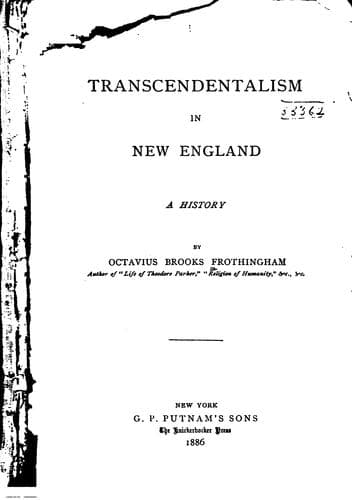
Transcendentalism in New England: A HistoryFrothingham, Octavius Brooks
Philosophy
Transcendentalism in New England: A History
Frothingham, Octavius Brooks
Transcendentalism (New England)
The Sensational philosophy had done a worse harm to the belief in
immortality, than by rendering the prospect of it uncertain; it had
rendered the character of it pusillanimous and plebeian; it had demanded
it on the ground that God must explain himself, must correct his
blunders and apologize for his partiality in distributing sugar plums;
it had argued for it from personal, social, sectarian, and other
sympathies and antipathies; it had expected it on the strength of a
rumor that a specially holy man, a saint of Judea, had appeared after
death to his peculiar friends; it had pleaded for it, as children beg
for dessert after bread and meat. The transcendental philosophy
dismissed these unworthy claims, made no demand, put up no petition, but
simply made articulate the prophecy of the spiritual nature in man, and
trusted the eternal goodness for its fulfilment. Other arguments might
come to the support of this anticipation; history might bring its
contribution of recorded facts; suffering and sorrow might add their
pathetic voices, bewailing the oppressive power of circumstance, and
crying for peace out of affliction; the biographies of Jesus might
furnish illustration of the victory of the greatest souls over death;
but considerations of this kind received their importance from the light
they threw on the immortal attributes of spirit. Apart from these their
significance was gone.
The pure Transcendentalists saw everywhere evidence of the greatness of
the soul. Christianity they regarded as its chief manifestation.
Imperfect Transcendentalists there were, who used the fundamental
postulates of the transcendental philosophy to confirm their faith in
supernatural realities. Their Transcendentalism amounted merely to
this, that man had a natural capacity for _receiving_ supernatural
truths, when presented by revelation. The _possession_ of such truths,
even in germ; the power to unfold them naturally, by process of mental
or spiritual growth; the faculty to seize, define, shape, legitimate and
enthrone them, they denied. The soul, according to them, was recipient,
not originating or creative. They continued to be Christians of the
"Evangelical" stamp; champions of special intervention of light and
grace; hearty believers in the divinity of the Christ and the saving
influence of the Holy Ghost; holding to the peculiar inspiration of the
Bible, and the personal need of regeneration. The wisest teachers of
orthodoxy belonged to this school.
Public-domain text, read in full here on John Shaqi.
Reviews
Reviews
No reviews yet
Be the first to share your thoughts on this work.
Elsewhere in the archive
Join the Discussion
Join the discussion
Sign in to leave a comment or review.
Sign InorCreate an account