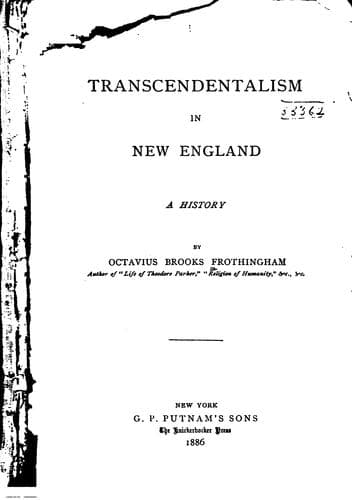
Transcendentalism in New England: A HistoryFrothingham, Octavius Brooks
Philosophy
Transcendentalism in New England: A History
Frothingham, Octavius Brooks
Transcendentalism (New England)
The pure Transcendentalist went much further. According to him, the
seeds of truth, if not the outline forms of truth, were contained in the
soul itself, all ready to expand in bloom and beauty, as it felt the
light and heat of the upper world. Sir Kenelm Digby relates that in
Padua he visited the laboratory of a famous physician, and was there
shown a small pile of fine ashes under a glass. On the application of a
gentle heat, it arose, assumed the shape of its original flower, all its
parts being perfectly distinct in form and well defined in character.
During the application of the heat, the spectral plant preserved its
delicate outline; but on withdrawal of the heat, it became dust again.
So, according to the Transcendentalist, the spiritual being of
man--which apparently is a heap of lifeless ashes on the surface of
material existence--when graciously shone upon by knowledge and love,
puts on divine attributes, glows with beauty, palpitates with joy, gives
out flashes of power, distils odors of sanctity, and exhibits the marks
of a celestial grace. The soul, when thus awakened, utters oracles of
wisdom, sings, prophesies, thunders decalogues, pronounces beatitudes,
discourses grandly of God and divine things, performs wonders of healing
on sick bodies and wandering minds, rises to heights of heroism and
saintliness.
From this point of vision, it was easy to survey the history of mankind,
and, in the various religions of the world, see the efforts of the soul
to express itself in scriptures, emblems, doctrines, altar forms,
architecture, painting, moods and demonstrations of piety. The
Transcendentalist rendered full justice to all these, studied them,
admired them, confessed their inspiration. Of these faiths Christianity
was cheerfully acknowledged to be the queen. The supremacy of Jesus was
granted with enthusiasm. His teachings were accepted as the purest
expressions of religious truth; His miracles were regarded as the
natural achievements of a soul of such originality and force. In his
address to the senior class in Divinity College, 1838, Mr. Emerson spoke
of Christ's miracles as being "one with the blowing clover and the
falling rain," and urged the young candidates for the ministry to let
his life and dialogues "lie as they befel, active and warm, part of
human life, and of the landscape, and of the cheerful day." When, in
1840, Theodore Parker wrote his "Levi Blodgett" letter, he believed in
miracles, the miracles of the New Testament and many others besides,
more than the Christians about him were willing to accept.
Public-domain text, read in full here on John Shaqi.
Reviews
Reviews
No reviews yet
Be the first to share your thoughts on this work.
Elsewhere in the archive
Join the Discussion
Join the discussion
Sign in to leave a comment or review.
Sign InorCreate an account