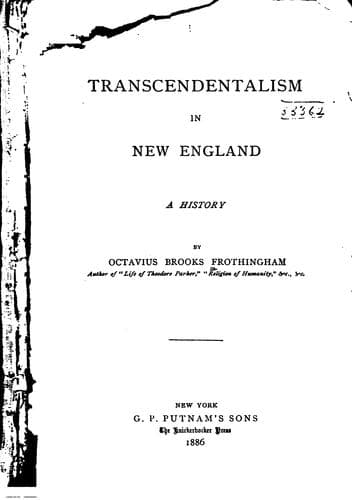
Transcendentalism in New England: A HistoryFrothingham, Octavius Brooks
Philosophy
Transcendentalism in New England: A History
Frothingham, Octavius Brooks
Transcendentalism (New England)
In the examination of Sir William Hamilton's Philosophy, he still more
emphatically expressed his dissent from Schelling, Cousin, and every
school of idealism, rejecting the doctrine of intuitive knowledge;
taking the eternal ground from beneath the ideas of the Infinite and
Absolute; sharply questioning the well-conceded interpretations of
consciousness; resolving the "first principles" into mental habits; and
even going so far as to doubt whether twice two necessarily made
four.[3]
[3] Vol. 1, page 89, 90.
The system of Spencer and other expositors of the doctrine of evolution
is, in its general features and its ultimate tendency, too familiar to
be stated. Its hostility to the intuitive philosophy must be obvious
even to unpractised minds. The atomic theory of the constitution of
matter, which, in one or another form, is accepted by the majority of
scientific men, gives ominous prediction of disaster to every scheme
that is built on the necessary truths of pure reason.
But the philosophers of the experimental school are by no means in
accord among themselves, on a matter so cardinal as the relation of mind
to organization. In the latest edition of the Logic, Mill repeats the
language used in the first:[4]
"That every mental state has a nervous state for its immediate
antecedent, though extremely probable, cannot hitherto be said to
be proved, in the conclusive manner in which this can be proved of
sensations; and even were it certain, yet every one must admit that
we are wholly ignorant of the characteristics of these nervous
states; we know not, and have no means of knowing, in what respect
one of them differs from another.... The successions, therefore,
which obtain among mental phenomena, do not admit of being deduced
from the physiological laws of our nervous organization." "It must
by no means be forgotten that the laws of mind may be derivative
laws resulting from laws of animal life, and that their truth,
therefore, may ultimately depend on physical conditions; and the
influence of physiological states or physiological changes in
altering or counter-acting the mental successions, is one of the
most important departments of psychological study. But on the other
hand, to reject the resource of psychological analysis, and
construct the theory of mind solely on such data as physiology
affords at present, seems to me as great an error in principle,
and an even more serious one in practice. Imperfect as is the
science of mind, I do not scruple to affirm that it is in a
considerably more advanced state than the portion of physiology
which corresponds with it; and to discard the former for the latter
appears to me to be an infringement of the true canons of inductive
philosophy."
[4] Logic, p. 591. Amer. Edition.
In a previous chapter[5] Mill had said:
Public-domain text, read in full here on John Shaqi.
Reviews
Reviews
No reviews yet
Be the first to share your thoughts on this work.
Elsewhere in the archive
Join the Discussion
Join the discussion
Sign in to leave a comment or review.
Sign InorCreate an account