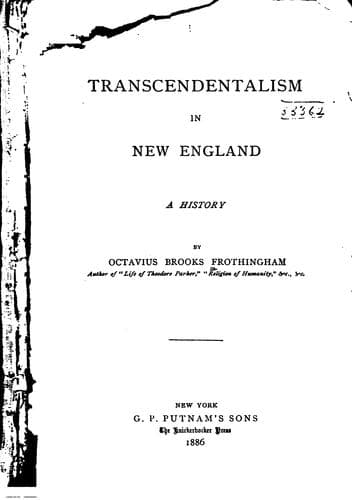
Transcendentalism in New England: A HistoryFrothingham, Octavius Brooks
Philosophy
Transcendentalism in New England: A History
Frothingham, Octavius Brooks
Transcendentalism (New England)
affected to resolve all the phenomena of the human mind into sensation,
by a process which essentially consisted in merely _calling_ all states
of mind, however heterogeneous, by that name; a philosophy now
acknowledged to consist solely of a set of verbal generalizations,
explaining nothing, distinguishing nothing, leading to nothing." The
"Sensational" philosophy is now presented as the philosophy of
"experience." Its occupation is to resolve into results of experience
and processes of organic life the _à priori_ conceptions that have been
accepted as simple and primitive data of consciousness, by the Ideal
philosophy. Mill was one of the first to undertake this from the
psychological side, analyzing the processes of reason, and making
account of the contents of the mind. Lewes, Spencer, Tyndall have
approached the same problem from the side of organization. In the first
edition of the Logic, Mill clearly indicated the ground he took in the
controversy between the two schools; in the last edition, he defined his
position more clearly, against Whewell, and in agreement with Bain.
In the article on Coleridge, published in the _London and Westminister
Review_, March, 1840, and republished in the second volume of
"Dissertations and Discussions," Mill declares explicitly, that in his
judgment, the truth on the much-debated question between the two
philosophies lies with the school of Locke and Bentham:
"The nature of laws and things in themselves, or the hidden causes
of the phenomena which are the objects of experience, appear to us
radically inaccessible to the human faculties. We see no ground for
believing that any thing can be the object of our knowledge except
our experience, and what can be inferred from our experience by the
analogies of experience itself; nor that there is any idea, feeling
or power in the human mind, which, in order to account for it,
requires that its origin should be referred to any other source. We
are, therefore, at issue with Coleridge on the central idea of his
philosophy; and we find no need of, and no use for, the peculiar
technical terminology which he and his masters, the Germans, have
introduced into philosophy, for the double purpose of giving
logical precision to doctrines which we do not admit, and of
marking a relation between those abstract doctrines and many
concrete experimental truths, which this language, in our judgment,
serves not to elucidate, but to disguise and obscure."
Public-domain text, read in full here on John Shaqi.
Reviews
Reviews
No reviews yet
Be the first to share your thoughts on this work.
Elsewhere in the archive
Join the Discussion
Join the discussion
Sign in to leave a comment or review.
Sign InorCreate an account