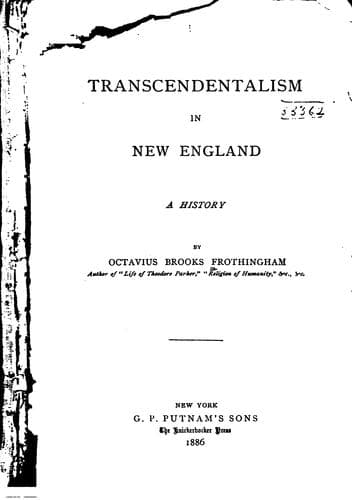
Transcendentalism in New England: A HistoryFrothingham, Octavius Brooks
Philosophy
Transcendentalism in New England: A History
Frothingham, Octavius Brooks
Transcendentalism (New England)
The position of John Tyndall is well understood. It was avowed in 1860
in the _Saturday Review_; again in his address to the Mathematical and
Physical Section of the British Association in 1868, wherein he declared
that
"The passage from the physics of the brain to the corresponding
facts of consciousness is unthinkable. Granted that a thought and
a definite molecular action in the brain occur simultaneously, we
do not possess the organ, nor, apparently, any rudiment of the
organ, which would enable us to pass by a process of reasoning from
the one phenomenon to the other. They appear together, but we do
not know why."
In 1875, reviewing Martineau in the _Popular Science Monthly_ for
December, Tyndall calls attention to these declarations, and quotes
other language of his own to the same purpose:
"You cannot satisfy the understanding in its demand for logical
continuity between molecular processes and the phenomena of
consciousness. This is a rock on which materialism must inevitably
split whenever it pretends to be a complete philosophy of the human
mind."
Mr. John Fiske, a disciple of Herbert Spencer, and an exceedingly able
expositor of the philosophy of which Spencer is the acknowledged chief,
makes assertions equally positive:[6]
"However strict the parallelism may be within the limits of our
experience, between the phenomena of the mind, and the segment of
the circle of motions, the task of transcending or abolishing the
radical antithesis between the phenomena of mind and the phenomena
of matter, must always remain an impracticable task; for, in order
to transcend or abolish this radical antithesis, we must be
prepared to show how a given quantity of molecular motion in nerve
tissue can be transformed into a definable amount of ideation or
feeling. But this, it is quite safe to say, can never be done."
[6] Outlines of Cosmic Philosophy, Vol. II., p. 442.
There are of course, distinguished names on the other side. The work on
"Intelligence," by Mr. Taine, which Mr. Mill warmly commends as the "the
first serious effort (in France) to supply the want of a better than the
official psychology," cannot be wisely overlooked by any one interested
in this problem. Taine objects to Tyndall's statement of the problem,
declares that by approaching it from another point, it is soluble, and
frankly undertakes to solve it.[7]
[7] On Intelligence, Book III., chap. I.
Public-domain text, read in full here on John Shaqi.
Reviews
Reviews
No reviews yet
Be the first to share your thoughts on this work.
Elsewhere in the archive
Join the Discussion
Join the discussion
Sign in to leave a comment or review.
Sign InorCreate an account