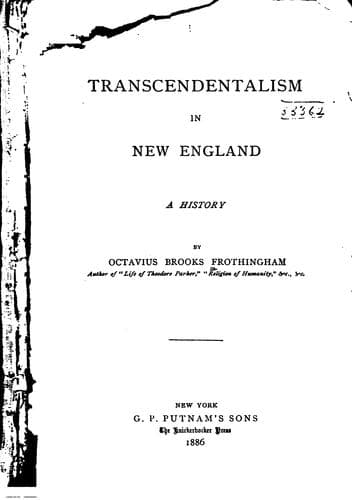
Transcendentalism in New England: A HistoryFrothingham, Octavius Brooks
Philosophy
Transcendentalism in New England: A History
Frothingham, Octavius Brooks
Transcendentalism (New England)
"When we consider closely any one of our conceptions--that of a
plant, an animal, a mineral--we find that the primitive threads of
which it is woven, are sensations, and sensations only. We have
proof of this already if we recollect that our ideas are only
reviving sensations, that our ideas are nothing more than images
which have become signs, and that thus this elementary tissue
subsists in a more or less disguised form at all stages of our
thought." "It is true that we cannot conceive the two events
otherwise than as irreducible to one another; but that may depend
on the way we conceive them, and not on their actual qualities;
their incompatibility is perhaps rather apparent than real; it
arises on our side and not on theirs."
Mr. George H. Lewes[8] follows closely Taine's line of argument, but
developes it with more system. He too quotes Tyndall, alludes to DuBois
Reymond and makes reference to Mill. Lewes holds it to be a severe
deduction from proven facts "that the neural process and the feeling are
one and the same process viewed under different aspects. Viewed from the
physical or objective side, it is a neural process; viewed from the
psychological or subjective side, it is a sentient process."
[8] Problems of Life and Mind II. pp. 410, 415.
"It is not wonderful that conceptions so dissimilar as those of
Motion and Feeling should seem irreducible to a common term, while
the one is regarded as the symbol of a process in the object, and
the other as the symbol of a process in the subject. But
psychological analysis leads to the conclusion that the objective
process and the subjective process are simply the twofold aspects
of one and the same fact; in the one aspect it is the Felt, in the
other it is the Feeling."
For the remarkable reasonings by which these assertions are justified,
the readers must consult the works quoted. Their novelty renders any but
an extended account of them unfair; and an extended account would be out
of place in a general study like this.
Public-domain text, read in full here on John Shaqi.
Reviews
Reviews
No reviews yet
Be the first to share your thoughts on this work.
Elsewhere in the archive
Join the Discussion
Join the discussion
Sign in to leave a comment or review.
Sign InorCreate an account