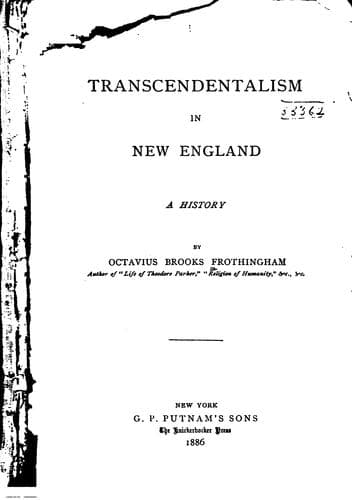
Transcendentalism in New England: A HistoryFrothingham, Octavius Brooks
Philosophy
Transcendentalism in New England: A History
Frothingham, Octavius Brooks
Transcendentalism (New England)
The Transcendental doctrine has been exposed to most deadly assault on
the ethical side. The theory of moral intuition, which held that "every
man is, according to the cautious statement of James Walker, born with a
moral faculty, or the elements of a moral faculty, which, on being
developed, creates in him the idea of a right and a wrong in human
conduct; which summons him before the tribunal of his own soul for
judgment on the rectitude of his purposes; which grows up into an
habitual sense of personal responsibility, and thus prepares him, as his
views are enlarged, to comprehend the moral government of God, and to
feel his own responsibility to God as a moral governor,"--has fallen
into general disrepute; and in its place a persuasion is abroad, that,
in the language of Grote, "the universal and essential tendencies of the
moral sense, admit of being most satisfactorily deduced from other
elementary principles of our nature." It is now a widely accepted belief
among conservative thinkers, that "conscience" is not a faculty, or an
element, existing here in germ, there in maturity; but is the result of
social experience. Moderate Transcendentalists conceded the necessity of
_educating_ conscience, which still implied the existence of a
conscience or moral sense to be educated. It is now contended that
conscience itself is a product of education, a deposit left in the
crucible of experiment, a habit formed by the usage of mankind. The
justification of this view has gone so far, that it seems likely to
become the recognized account of this matter; but in course of
substantiating this doctrine, a new foundation for ethical feeling and
judgment is laid, which is as immovable as the transcendental "facts of
consciousness." The moral sentiments are represented as resting on the
entire past of the race, on reefs of fact built up by the lives of
millions of men, from the bottom of the deep of humanity. The finest
moral sensibility caps the peak of the world's effort at
self-adjustment, as the white, unsullied snow rests on the summit of
the Jungfrau. The intuition is referred to in another genesis, but it is
equally clear and equally certain. The difference of origin creates no
difference of character. Moral distinctions are precisely the same for
idealists and sensationalists. Here at least, the transcendentalist and
his adversary can dwell in amity together.
IX.
THE SEER.
Public-domain text, read in full here on John Shaqi.
Reviews
Reviews
No reviews yet
Be the first to share your thoughts on this work.
Elsewhere in the archive
Join the Discussion
Join the discussion
Sign in to leave a comment or review.
Sign InorCreate an account