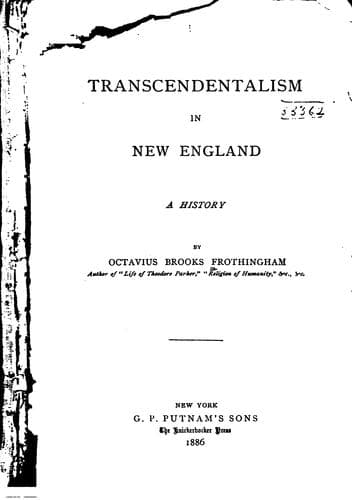
Transcendentalism in New England: A HistoryFrothingham, Octavius Brooks
Philosophy
Transcendentalism in New England: A History
Frothingham, Octavius Brooks
Transcendentalism (New England)
A discerning German writer, Herman Grimm, closes a volume of fifteen
essays, with one on Ralph Waldo Emerson, written in 1861, approved in
1874. The essay is interesting, apart from its literary merit, as giving
the impression made by Mr. Emerson on a foreigner to whom his reputation
was unknown, and a man of culture to whom books and opinions rarely
brought surprise. He saw a volume of the "Essays" lying on the table of
an American acquaintance, looked into it, and was surprised that, being
tolerably well practised in reading English, he understood next to
nothing of the contents. He asked about the author, and, learning that
he was highly esteemed in his own country, he opened the book again,
read further, and was so much struck by passages here and there, that he
borrowed it, carried it home, took down Webster's dictionary, and began
reading in earnest. The extraordinary construction of the sentences, the
apparent absence of logical continuity, the unexpected turns of thought,
the use of original words, embarrassed him at first; but soon he
discovered the secret and felt the charms. The man had fresh thoughts,
employed a living speech, was a genuine person. The book was bought,
read and re-read, "and now every time I take it up, I seem to take it up
for the first time."
The power that the richest genius has in Shakspeare, Rafael, Goethe,
Beethoven, to reconcile the soul to life, to give joy for heaviness, to
dissipate fears, to transfigure care and toil, to convert lead into
gold, and lift the veil that conceals the forms of hope, Grimm ascribes
in the highest measure to Emerson.
"As I read, all seems old and familiar as if it was my own
well-worn thought; all seems new as if it never occurred to me
before. I found myself depending on the book and was provoked with
myself for it. How could I be so captured and enthralled; so
fascinated and bewitched? The writer was but a man like any other;
yet, on taking up the volume again, the spell was renewed--I felt
the pure air; the old weather-beaten motives recovered their tone."
To him Emerson seemed to stand on the ground of simple fact, which he
accepted in all sincerity.
Public-domain text, read in full here on John Shaqi.
Reviews
Reviews
No reviews yet
Be the first to share your thoughts on this work.
Elsewhere in the archive
Join the Discussion
Join the discussion
Sign in to leave a comment or review.
Sign InorCreate an account