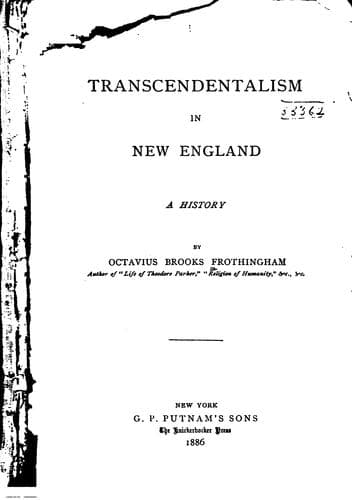
Transcendentalism in New England: A HistoryFrothingham, Octavius Brooks
Philosophy
Transcendentalism in New England: A History
Frothingham, Octavius Brooks
Transcendentalism (New England)
The sermon alluded to was a model of lucid, orderly and simple
statement, so plain that the young men and women of the congregation
could understand it; so deep and elevated that experienced believers
were fed; learned enough, without a taint of pedantry; bold, without a
suggestion of audacity; reasonable, without critical sharpness or
affectation of mental superiority; rising into natural eloquence in
passages that contained pure thought, but for the most part flowing in
unartificial sentences that exactly expressed the speaker's meaning and
no more. By Mr. Emerson's kind permission, the discourse is printed in
the last chapter of this volume. The farewell letter to the parish is
also printed here.
BOSTON, 22d December, 1832.
_To the Second Church and Society_:
CHRISTIAN FRIENDS:--Since the formal resignation of my official
relation to you in my communication to the proprietors in
September, I had waited anxiously for an opportunity of addressing
you once more from the pulpit, though it were only to say, let us
part in peace and in the love of God. The state of my health has
prevented, and continues to prevent me from so doing. I am now
advised to seek the benefit of a sea voyage. I cannot go away
without a brief parting word to friends who have shown me so much
kindness, and to whom I have felt myself so dearly bound.
Our connection has been very short; I had only begun my work. It is
now brought to a sudden close; and I look back, I own, with a
painful sense of weakness, to the little service I have been able
to render, after so much expectation on my part,--to the checkered
space of time, which domestic affliction and personal infirmities
have made yet shorter and more unprofitable.
As long as he remains in the same place, every man flatters
himself, however keen may be his sense of his failures and
unworthiness, that he shall yet accomplish much; that the future
shall make amends for the past; that his very errors shall prove
his instructors,--and what limit is there to hope? But a separation
from our place, the close of a particular career of duty, shuts the
book, bereaves us of this hope, and leaves us only to lament how
little has been done.
Public-domain text, read in full here on John Shaqi.
Reviews
Reviews
No reviews yet
Be the first to share your thoughts on this work.
Elsewhere in the archive
Join the Discussion
Join the discussion
Sign in to leave a comment or review.
Sign InorCreate an account