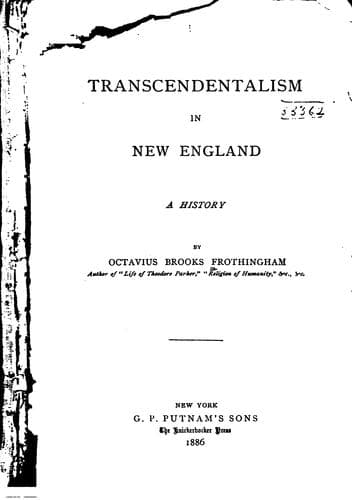
Transcendentalism in New England: A HistoryFrothingham, Octavius Brooks
Philosophy
Transcendentalism in New England: A History
Frothingham, Octavius Brooks
Transcendentalism (New England)
"I confess that everything connected with our personality fails.
Nature never spares the individual. We are always balked of a
complete success. No prosperity is promised to _that_. We have our
indemnity only in the success of that to which we belong. _That_ is
immortal, and we only through that." "Future state is an illusion
for the ever present state. It is not length of life, but depth of
life. It is not duration, but a taking of the soul out of time, as
all high action of the mind does; when we are living in the
sentiments we ask no questions about time. The spiritual world
takes place--that which is always the same."
Goethe is quoted to the same purpose:
"It is to a thinking being quite impossible to think himself
non-existent, ceasing to think and live; so far does every one
carry in himself the proof of immortality, and quite spontaneously.
But so soon as the man will be objective and go out of himself, so
soon as he dogmatically will grasp a personal duration to bolster
up in cockney fashion that inward assurance, he is lost in
contradiction."
It is thought worth while to dwell so long on this point, because it
furnishes a perfect illustration of Emerson's intellectual attitude
towards beliefs, its entire sincerity, disinterestedness and modesty.
The serenity of his faith makes it impossible for him to be a
controversialist. He never gave a sweeter or more convincing proof of
this than in the sermon he preached on the Communion Supper, which
terminated his connection with his Boston parish, and with it his
relations to the Christian ministry, after a short service of less than
four years. The rite in question was held sacred by his sect, as a
personal memorial of Jesus perpetuated according to his own request. To
neglect it was still regarded as a reproach; to dispute its authority
was considered contumacious; to declare it obsolete and useless, an
impediment to spiritual progress, a hindrance to Christian growth, was
to excite violent animosities, and call down angry rebuke. Yet this is
what Mr. Emerson deliberately did. That the question of retaining a
minister who declined to bless and distribute the bread and wine, was
debated at all, was proof of the extraordinary hold he had on his
people. Through the crisis he remained unruffled, calm and gracious as
in the sunniest days. On the evening when the church were considering
his final proposition, with such result as he clearly foresaw, he sat
with a brother clergyman talking pleasantly on literature and general
topics, never letting fall a hint of the impending judgment, until, as
he rose to leave, he said gently, "this is probably the last time we
shall meet as brethren in the same calling," added a few words in
explanation of the remark, and passed into the street.
Public-domain text, read in full here on John Shaqi.
Reviews
Reviews
No reviews yet
Be the first to share your thoughts on this work.
Elsewhere in the archive
Join the Discussion
Join the discussion
Sign in to leave a comment or review.
Sign InorCreate an account