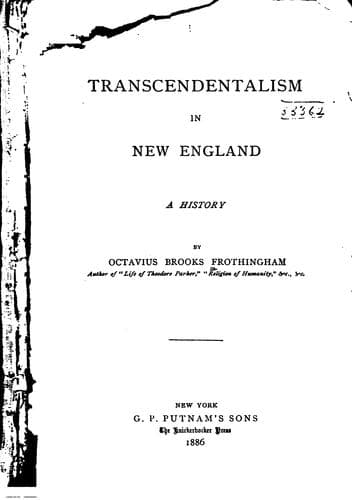
Transcendentalism in New England: A HistoryFrothingham, Octavius Brooks
Philosophy
Transcendentalism in New England: A History
Frothingham, Octavius Brooks
Transcendentalism (New England)
Mr. Emerson is never concerned to defend himself against the charge of
pantheism, or the warning to beware lest he unsettle the foundations of
morality, annihilate the freedom of the will, abolish the distinction
between right and wrong, and reduce personality to a mask. He makes no
apology; he never explains; he trusts to affirmation, pure and simple.
By dint of affirming all the facts that appear, he makes his
contribution to the problem of solving all, and by laying incessant
emphasis on the cardinal virtues of humility, fidelity, sincerity,
obedience, aspiration, simple acquiescence in the will of the supreme
power, he not only guards himself against vulgar misconception, but
sustains the mind at an elevation that makes the highest hill-tops of
the accepted morality disappear in the dead level of the plain.
The primary thoughts of his philosophy, if such it may be termed,
Emerson takes with him wherever he goes. Does he study history, history
is the autobiography of the Eternal Mind. The key is in the sentence
that begins the Essay on History:
"There is one mind common to all individual men. Every man is an
inlet to the same, and to all of the same. He that is once admitted
to the right of reason is made a freeman of the whole estate. What
Plato has thought, he may think; what a saint has felt, he may
feel; what at any time has befallen any man, he can understand. Who
hath access to this universal mind, is a party to all that is or
can be done, for that is the only and sovereign agent." "This human
mind wrote history, and this must read it. The sphinx must solve
her own riddle. If the whole of history is in one man, it is all to
be explained from individual experience. There is a relation
between the hours of our life and the centuries of time. Of the
universal mind each individual man is one more incarnation. All its
properties consist in him. Each new fact in his private experience
flashes a light on what great bodies of men have done, and the
crises of his life refer to national crises." In the "Progress of
Culture" the same sentiment recurs.
"What is the use of telegraphy? What of newspapers? To know in each
social crisis how men feel in Kansas, in California, the wise man
waits for no mails, reads no telegrams. He asks his own heart. If
they are made as he is, if they breathe the same air, eat of the
same wheat, have wives and children, he knows that their joy or
resentment rises to the same point as his own. The inviolate soul
is in perpetual telegraphic communication with the Source of
events, has earlier information, a private despatch, which relieves
him of the terror which presses on the rest of the community."
Public-domain text, read in full here on John Shaqi.
Reviews
Reviews
No reviews yet
Be the first to share your thoughts on this work.
Elsewhere in the archive
Join the Discussion
Join the discussion
Sign in to leave a comment or review.
Sign InorCreate an account