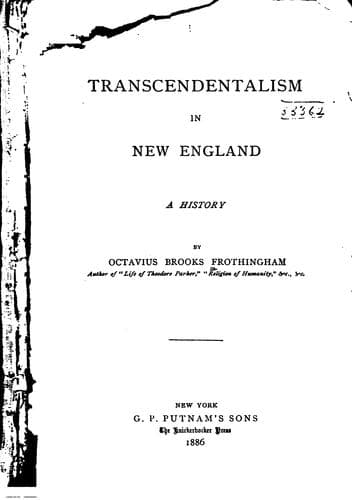
Transcendentalism in New England: A HistoryFrothingham, Octavius Brooks
Philosophy
Transcendentalism in New England: A History
Frothingham, Octavius Brooks
Transcendentalism (New England)
"We are always coming up with the emphatic facts of history in our
private experience, and verifying them here. All history becomes
subjective; in other words, there is properly no history; only
biography. Every mind must know the whole lesson for itself,--must
go over the whole ground. What it does not see, what it does not
live, it does not know."
In the appreciation of scientific facts the same method avails. Tyndall
commends Emerson as "a poet and a profoundly religious man, who is
really and entirely undaunted by the discoveries of science, past,
present, or prospective." The praise seems to imply some misconception
of Emerson's position. Tyndall intimates that Emerson is undaunted where
others fear. But this is not so. No man deserves commendation for not
dreading precisely what he desires. Emerson, by his principle, is
delivered from the alarm of the religious man who has a creed to defend,
and from the defiance of the scientific man who has creeds to assail. To
him Nature is but the symbol of spirit; this the scientific men, by
their discoveries, are continually proving. The faster they disclose
facts, and the more accurately, the more brilliantly do they illustrate
the lessons of the perfect wisdom. For the scientific _method_ he
professes no deep respect; for the scientific _assumptions_ none
whatever. He begins at the opposite end. They start with matter, he
starts with mind. They feel their way up, he feels his way down. They
observe phenomena, he watches thoughts. They fancy themselves to be
gradually pushing away as illusions the so-called entities of the soul;
he dwells serenely with those entities, rejoicing to see men paying
jubilant honor to what they mean to overturn. The facts they bring in,
chemical, physiological, biological, Huxley's facts, Helmholtz's,
Darwin's, Tyndall's, Spencer's, the ugly facts which the theologians
dispute, he accepts with eager hands, and uses to demonstrate the force
and harmony of the spiritual laws.
Public-domain text, read in full here on John Shaqi.
Reviews
Reviews
No reviews yet
Be the first to share your thoughts on this work.
Elsewhere in the archive
Join the Discussion
Join the discussion
Sign in to leave a comment or review.
Sign InorCreate an account