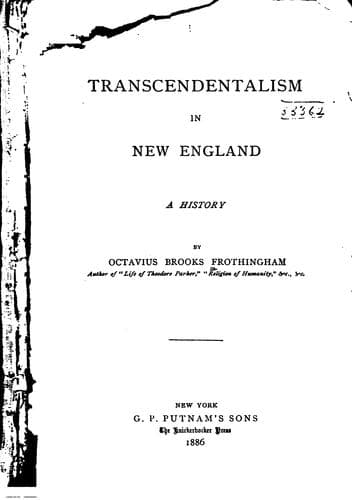
Transcendentalism in New England: A HistoryFrothingham, Octavius Brooks
Philosophy
Transcendentalism in New England: A History
Frothingham, Octavius Brooks
Transcendentalism (New England)
when so many thoughts are forgotten, buried beneath affectation and
verbiage, his gain in brilliancy and value as time goes on; and in an
age of ephemeral literature his books find new readers, his mind exerts
wider sway. That his philosophy can be recommended as a sound rule to
live by for ordinary practitioners may be questioned. It is better as
inspiration than as prescription. For maxims it were wiser to go to
Bentham, Mill or Bain. The plodders had best keep to the beaten road.
But for them who need an atmosphere for wings, who require the impulse
of great motives, the lift of upbearing aspirations--for the
imaginative, the passionate, the susceptible, who can achieve nothing
unless they attempt the impossible--Emerson is the master. A single
thrill sent from his heart to ours is worth more to the heart that feels
it, than all the schedules of motive the utilitarian can offer.
X.
THE MYSTIC.
If among the representatives of spiritual philosophy the first place
belongs to Mr. Emerson, the second must be assigned to Mr. Amos Bronson
Alcott,--older than Mr. Emerson by four years (he was born in 1779), a
contemporary in thought, a companion, for years a fellow townsman, and,
if that were possible, more purely and exclusively a devotee of
spiritual ideas. Mr. Alcott may justly be called a mystic--one of the
very small class of persons who accept without qualification, and
constantly teach the doctrine of the soul's primacy and pre-eminence. He
is not a learned man, in the ordinary sense of the term; not a man of
versatile mind or various tastes; not a man of general information in
worldly or even literary affairs; not a man of extensive commerce with
books. Though a reader, and a constant and faithful one, his reading has
been limited to books of poetry--chiefly of the meditative and interior
sort--and works of spiritual philosophy. Plato, Plotinus, Proclus,
Jamblichus, Pythagoras, Boehme, Swedenborg, Fludd, Pordage, Henry More,
Law, Crashaw, Selden, are the names oftener than any on his pages and
lips. He early made acquaintance with Bunyan's "Pilgrim's Progress,"
and never ceased to hold it exceedingly precious, at one period making
it a rule to read the volume once a year. His books are his friends; his
regard for them seems to be personal; he enjoys their society with the
feeling that he gives as well as receives. He loves them in part because
they love him; consequently, in all his quoting of them, his own mind
comes in as introducer and voucher as it were. His indebtedness to them
is expressed with the cordiality of an intimate, rather than with the
gratitude of a disciple. His own mind is so wakeful and thoughtful, so
quick and ready to take the initiative, that it is hard to say in what
respect even his favorite and familiar authors have enriched him. What
was not originally his own, is so entirely made his own by sympathetic
absorption, that the contribution which others have made is not to be
distinguished from his native stores.
Public-domain text, read in full here on John Shaqi.
Reviews
Reviews
No reviews yet
Be the first to share your thoughts on this work.
Elsewhere in the archive
Join the Discussion
Join the discussion
Sign in to leave a comment or review.
Sign InorCreate an account