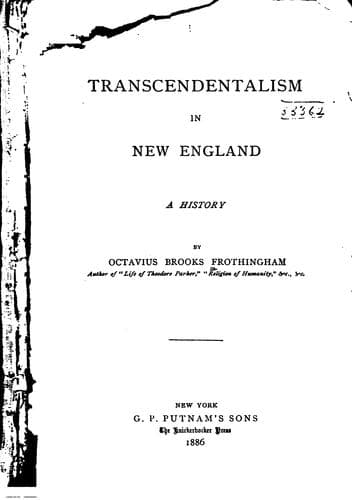
Transcendentalism in New England: A HistoryFrothingham, Octavius Brooks
Philosophy
Transcendentalism in New England: A History
Frothingham, Octavius Brooks
Transcendentalism (New England)
"Consider," he says, "how largely our letters have been enriched by
his contributions. Consider, too, the change his views have wrought
in our methods of thinking; how he has won over the bigot, the
unbeliever, at least to tolerance and moderation, if not
acknowledgment, by his circumspection and candor of statement." "A
poet, speaking to individuals as few others can speak, and to
persons in their privileged moments, he is heard as none others
are. 'Tis every thing to have a true believer in the world, dealing
with men and matters as if they were divine in idea and real in
fact, meeting persons and events at a glance, directly, not at a
millionth remove, and so passing fair and fresh into life and
literature." "His compositions affect us, not as logic linked in
syllogisms, but as voluntaries rather, as preludes, in which one is
not tied to any design of air, but may vary his key or not at
pleasure, as if improvised without any particular scope of
argument; each period, paragraph, being a perfect note in itself,
however it may chance chime with its accompaniments in the piece,
as a waltz of wandering stars, a dance of Hesperus with Orion."
After this, one is surprised to hear Mr. Alcott say, "I know of but one
subtraction from the pleasure the reading of his books--shall I say his
conversation?--gives me; his pains to be impersonal or discreet, as if
he feared any the least intrusion of himself were an offence offered to
self-respect, the courtesy due to intercourse and authorship." To others
this exquisite reserve, this delicate withdrawal behind his thought, has
seemed not only one of Emerson's peculiar charms, but one of his most
subtle powers. Personal magnetism is very delightful for the moment. The
exhibition of attractive personal traits is interesting in the lecture
room; sometimes in the parlor. The public, large or small, enjoy
confidences. But in an age of personalities, voluntary and involuntary,
the man who keeps his individual affairs in the background, tells
nothing of his private history, holds in his own breast his petty
concerns and opinions, and lets thoughts flow through him, as light
streams through plate glass, is more than attractive--is noble, is
venerable. To his impersonality in his books and addresses, Emerson owes
perhaps a large measure of his extraordinary influence. You may search
his volumes in vain for a trace of egotism. In the lecture room, he
seems to be so completely under the spell of his idea, so wholly
abstracted from his audience, that he is as one who waits for the
thoughts to come, and drops them out one by one, in a species of
soliloquy or trance. He is a bodiless idea. When he speaks or writes,
the power is that of pure mind. The incidental, accidental, occasional,
does not intrude. No abatement on the score of personal antipathy needs
to be made. The thought is allowed to present and commend itself. Hence,
Public-domain text, read in full here on John Shaqi.
Reviews
Reviews
No reviews yet
Be the first to share your thoughts on this work.
Elsewhere in the archive
Join the Discussion
Join the discussion
Sign in to leave a comment or review.
Sign InorCreate an account