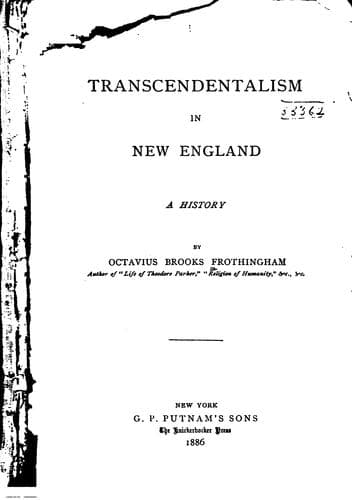
Transcendentalism in New England: A HistoryFrothingham, Octavius Brooks
Philosophy
Transcendentalism in New England: A History
Frothingham, Octavius Brooks
Transcendentalism (New England)
"Of the great educators of antiquity, I esteem Pythagoras the most
eminent and successful; everything of his doctrine and discipline
comes commended by its elegance and humanity, and justifies the
name he bore of the golden-souled Samian, and founder of Greek
culture. He seems to have stood in providential nearness to human
sensibility, as if his were a maternal relation as well, and he
owned the minds whom he nurtured and educated. The first of
philosophers, taking the name for its modesty of pretension, he
justified his claim to it in the attainments and services of his
followers; his school having given us Socrates, Plato, Pericles,
Plutarch, Plotinus, and others of almost equal fame, founders of
states and cultures.... He was reverenced by the multitude as one
under the influence of divine inspiration. He abstained from all
intoxicating drinks, and from animal food, confining himself to a
chaste nutriment; hence his sleep was short and undisturbed; his
soul vigilant and pure; his body in state of perfect and invariable
health. He was free from the superstitions of his time, and
pervaded with a deep sense of duty towards God, and veneration for
his divine attributes and immanency in things. He fixed his mind so
intently on the attainment of wisdom, that systems and mysteries
inaccessible to others were opened to him by his magic genius and
sincerity of purpose. The great principle with which he started,
that of being a seeker rather than a possessor of truth, seemed
ever to urge him forward with a diligence and activity
unprecedented in the history of the past, and perhaps unequalled
since. He visited every man who could claim any degree of fame for
wisdom or learning; whilst the rules of antiquity and the simplest
operations of nature seemed to yield to his researches; and we
moderns are using his eyes in many departments of activity into
which pure thought enters, being indebted to him for important
discoveries alike in science and metaphysics."
It is evident that the New England sage made the Greek philosopher his
model in other respects than the adoption of his philosophical method
implied. The rules of personal conduct and behavior, of social
intercourse, and civil association, were studiously practised on by the
American disciple, who seemed never to forget the dignified and gracious
figure whose fame charmed him.
Mr. Alcott's philosophical ideas are not many, but they are profound and
significant.
Public-domain text, read in full here on John Shaqi.
Reviews
Reviews
No reviews yet
Be the first to share your thoughts on this work.
Elsewhere in the archive
Join the Discussion
Join the discussion
Sign in to leave a comment or review.
Sign InorCreate an account