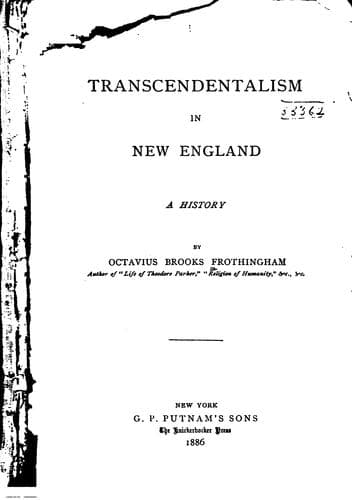
Transcendentalism in New England: A HistoryFrothingham, Octavius Brooks
Philosophy
Transcendentalism in New England: A History
Frothingham, Octavius Brooks
Transcendentalism (New England)
"The Dialectic, or Method of the Mind,"--he says in "Concord Days,"
under the head of Ideal Culture,--"constitutes the basis of all
culture. Without a thorough discipline in this, our schools and
universities give but a showy and superficial training. The
knowledge of mind is the beginning of all knowledge; without this,
a theology is baseless, the knowledge of God impossible. Modern
education has not dealt with these deeper questions of life and
being. It has the future in which to prove its power of conducting
a cultus answering to the discipline of the Greek thinkers,
Pythagoras, Plato, Aristotle."
"As yet we deal with mind with far less certainty than with matter;
the realm of intellect having been less explored than the world of
the senses, and both are treated conjecturally rather than
absolutely. When we come to perceive that intuition is the primary
postulate of all intelligence, most questions now perplexing and
obscure will become transparent; the lower imperfect methods then
take rank where they belong, and are available. The soul leads the
senses; the reason the understanding; imagination the memory;
instinct and intuition include and prompt the Personality entire."
"The categories of imagination are the poet's tools; those of the
reason, the implements of the naturalist. The dialectic philosopher
is master of them both. The tools to those only who can handle them
skilfully. All others but gash themselves and their subject at
best. Ask not a man of understanding to solve a problem in
metaphysics. He has neither wit, weight, nor scales for the task.
But a man of reason or of imagination solves readily the problems
of understanding, the moment these are fairly stated. Ideas are
solvents of all mysteries, whether in matter or in mind."
"Having drank of immortality all night, the genius enters eagerly
upon the day's task, impatient of any impertinences jogging the
full glass.... Sleep and see; wake, and report the nocturnal
spectacle. Sleep, like travel, enriches, refreshes, by varying the
day's perspective, showing us the night side of the globe we
traverse day by day. We make transits too swift for our wakeful
senses to follow; pass from solar to lunar consciousness in a
twinkling; lapse from forehead and face to occupy our lower parts,
and recover, as far as permitted, the keys of genesis and of the
fore worlds. 'All truth,' says Porphyry, 'is latent;' but this the
soul sometimes beholds, when she is a little liberated by sleep
from the employments of the body, and sometimes she extends her
sight, but never perfectly reaches the objects of her vision."
Public-domain text, read in full here on John Shaqi.
Reviews
Reviews
No reviews yet
Be the first to share your thoughts on this work.
Elsewhere in the archive
Join the Discussion
Join the discussion
Sign in to leave a comment or review.
Sign InorCreate an account