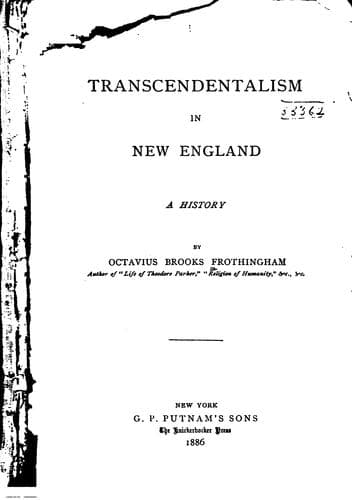
Transcendentalism in New England: A HistoryFrothingham, Octavius Brooks
Philosophy
Transcendentalism in New England: A History
Frothingham, Octavius Brooks
Transcendentalism (New England)
"The good alone dream divinely. Our dreams are characteristic of
our waking thoughts and states; we are never out of character;
never quite another, even when fancy seeks to metamorphose us
entirely. The Person is One in all the manifold phases of the Many,
through which we transmigrate, and we find ourself perpetually,
because we cannot lose ourself personally in the mazes of the many.
'Tis the one soul in manifold shapes. Ever the old friend of the
mirror in other face, old and new, yet one in endless revolution
and metamorphosis, suggesting a common relationship of forms at
their base, with divergent types as these range wider and farther
from their central archetype, including all concrete forms in
nature, each returning into other, and departing therefrom in
endless revolution."
"What is the bad but lapse from good,--the good blindfolded?"
"One's foes are of his own household. If his house is haunted, it
is by himself only. Our choices are our Saviors or Satans."
"The celestial man is composed more largely of light and ether. The
demoniac man of fire and vapor. The animal man of embers and
dust."
"The sacraments, symbolically considered, are
Baptism, or purification by water;
Continence, or chastity in personal indulgences;
Fasting, or temperance in outward delights;
Prayer, or aspiring aims;
Labor, or prayer in act or pursuits.
These are the regimen of inspiration and thought."
The following, from the chapter entitled "Genesis and Lapse," in
"Concord Days," extends Mr. Alcott's principle to a deep problem in
speculative truth. He quotes Coleridge thus:
"The great maxim in legislation, intellectual or physical, is
_subordinate_, not _exclude_. Nature, in her ascent, leaves nothing
behind; but at each step subordinates and glorifies,--mass,
crystal, organ, sensation, sentience, reflection."
Then he proceeds:
"Taken in reverse order of descent, spirit puts itself before; at
each step protrudes faculty in feature, function, organ, limb,
subordinating to glorify also,--person, volition, thought,
sensibility, sense, body,--animating thus and rounding creation to
soul and sense alike. The naturalist cannot urge too strongly the
claims of physical, nor the plea of the idealist be too vigorously
pressed for metaphysical studies. One body in one soul. Nature and
spirit are inseparable, and are best studied as a unit. Nature ends
where spirit begins. The idealist's point of view is the obverse of
the naturalist's, and each must accost his side with a first love
before use has worn off the bloom, and seduced their vision....
Public-domain text, read in full here on John Shaqi.
Reviews
Reviews
No reviews yet
Be the first to share your thoughts on this work.
Elsewhere in the archive
Join the Discussion
Join the discussion
Sign in to leave a comment or review.
Sign InorCreate an account