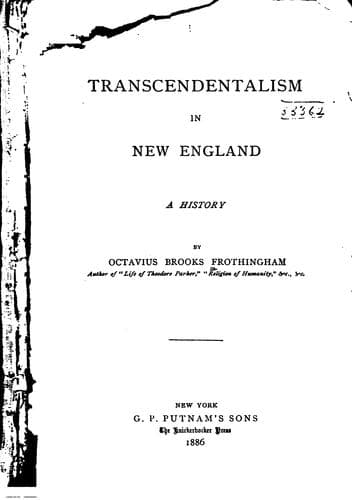
Transcendentalism in New England: A HistoryFrothingham, Octavius Brooks
Philosophy
Transcendentalism in New England: A History
Frothingham, Octavius Brooks
Transcendentalism (New England)
A single summer and autumn dissipated
the hopes planted there, and with them the faith that the world could be
refashioned by artificial arrangements of circumstances.
The surprising thing was, that such a man should ever have fallen into
the notion that it could; he was an idealist; his faith was in the
soul--not in organization of any sort; he was a regenerator, not a
reformer. All the good work he had done was of the regenerative kind,
through an awakening of the spiritual powers of individuals. His mission
was to educate--to draw out souls, whether of children or adults. Faith
in the soul was his inspiration and his guide. He early accepted the
office of teacher, made it the calling of his life, and in the exercise
of it, kept in mind this faith in the soul as the highest of
qualifications. To understand his enthusiasm, it is only necessary to
apprehend his idea. In the chapter on Childhood, in "Concord Days," that
idea is thus conveyed:
"To conceive a child's acquirements as originating in nature,
dating from his birth into his body, seems an atheism that only a
shallow metaphysical theology could entertain in a time of such
marvellous natural knowledge as ours. 'I shall never persuade
myself,' says Synesius, 'to believe my soul to be of like age with
my body.' And yet we are wont to date our birth, as that of the
babes we christen, from the body's advent, so duteously inscribed
in our family registers, as if time and space could chronicle the
periods of the immortal mind, and mark its longevity by our
chronometers. Only a God could inspire a child with the intimations
seen in its first pulse-plays; the sprightly attainments of a
single day's doings afford the liveliest proofs of an omniscient
Deity, revealing His attributes in the motions of the little
one!... Were the skill for touching its tender sensibilities,
calling forth its budding gifts, equal to the charms the child has
for us, what noble characters would graduate from our families--the
community receiving its members accomplished in the personal
graces, the state its patriots, the church its saints, all
glorifying the race."
Public-domain text, read in full here on John Shaqi.
Reviews
Reviews
No reviews yet
Be the first to share your thoughts on this work.
Elsewhere in the archive
Join the Discussion
Join the discussion
Sign in to leave a comment or review.
Sign InorCreate an account