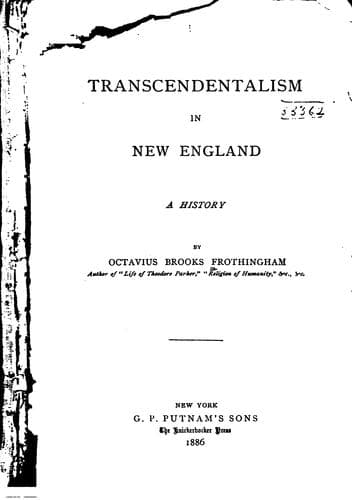
Transcendentalism in New England: A HistoryFrothingham, Octavius Brooks
Philosophy
Transcendentalism in New England: A History
Frothingham, Octavius Brooks
Transcendentalism (New England)
In the year 1817 some strong interior visitations came over me,
which withdrew me from the world in a considerable degree, and I
was enabled to yield myself up to Love's own manner of acting,
regardless of all consequences. Soon after this time, I met with an
account of the Spirit's work in and by the late venerable
Pestalozzi, which so interested me that I proceeded at once to
visit him in Switzerland, and remained with him in holy fellowship
four years. After that I was working with considerable success
amongst the various students in that country, when the prejudices
of the self-made wise and powerful men became jealous of my
influence, and I was advised to return to England, which I did; and
have been working in various ways of usefulness ever since, from
the deep centre to the circumference; and am now engaged in writing
my conscientious experiences as well as I can represent them in
words, and in teaching all such as come within my sphere of action.
Receptive beings, however, have as yet been but limited, and those
who permanently _retain_, have been still less; yet, at present,
there appears a greater degree of awakening to the central
love-sensibility than before. I see many more symptoms of the
harvest-time approaching in this country. There is, at present, no
obvious appearance of the Love-seed beginning to germinate.
* * * * *
The child has two orders of faculties which are to be educated,
essential and semi-essential; or in other words, roots and
branches.
Radical faculties belong to the interior world, and the branchial
to the exterior.
To _produce_ a central effect on the child, the radical faculties
must be first developed; to _represent_ this effect, the branchial
faculties must be developed.
The radical faculties belong entirely to Love; the branchial to
knowledge and industry.
It is imperative upon us to follow the determination of the radical
faculties, and to modify the branchial always in obedience to the
radical.
It is the child, or the Love-Spirit in the child, that we must
obey, and not suffer the Parents or any one else to divert us from
it.
Good is not to be determined by man's wishes, but Good must
originate and determine the wish.
The Preceptor must watch attentively for every new exhibition of
the child's radical faculties, and obey them as divine laws.
We must in every movement consider that it is the Infinite
perfecting the finite.
All that is unnecessary in the external must be kept from the
child.
The Preceptor's duty is, as far as possible, to remove every
hindrance out of the child's way.
The closer he keeps the child to the Spirit, the less it will want
of us, or anyone else.
Public-domain text, read in full here on John Shaqi.
Reviews
Reviews
No reviews yet
Be the first to share your thoughts on this work.
Elsewhere in the archive
Join the Discussion
Join the discussion
Sign in to leave a comment or review.
Sign InorCreate an account