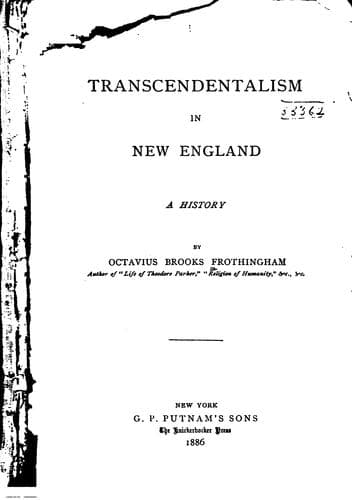
Transcendentalism in New England: A HistoryFrothingham, Octavius Brooks
Philosophy
Transcendentalism in New England: A History
Frothingham, Octavius Brooks
Transcendentalism (New England)
The child has an inward, sacred, and unchangeable nature; which
nature is the Temple of Love. This nature only demands what it will
give, if properly attended to, viz.: Unfettered Liberty.
The Love Germs can alone germinate with Love. Light and Life are
but conditions of Love. Divine capacities are made by love alone.
Love education is primarily a passive one; and, secondarily, an
active one. To educate the radical faculties is altogether a new
idea with Teachers at present.
The parental end must be made much more prominent than it has been.
The conceptive powers want much more purification than the
perceptive; and it is only as we purify the conceptive that we
shall get the perceptive clear.
It is the essential conceptive powers that tinge all the
consequences of the exterior conceptive powers.
We have double conceptions, and double perceptions; we are
throughout double beings; and claim the universal morality, as well
as the personal.
We must now educate the universal moral faculties, as before we
have only educated the personal moral faculties.
It is in the universal moral faculties that the laws reside; until
these laws are developed, we remain lawless beings.
The personal moral faculties cannot stand without the aid of the
universal moral faculties, any more than the branches can grow
without the roots.
Education, to be decidedly religious, should reach man's universal
faculties, those faculties which contain the laws that connect man
with his maker.
These reflections seem to me to be worthy of consideration. Should
any of them strike you as worth while to make an observation upon,
I shall be happy to hear it. Suggestions are always valuable, as
they offer to the mind the liberty of free activity. The work we
are engaged in is too extensive and important, to lose any
opportunity of gaining information.
The earlier I receive your reply, the better.
I am, dear Sir, yours faithfully,
J. P. GREAVES.
Public-domain text, read in full here on John Shaqi.
Reviews
Reviews
No reviews yet
Be the first to share your thoughts on this work.
Elsewhere in the archive
Join the Discussion
Join the discussion
Sign in to leave a comment or review.
Sign InorCreate an account