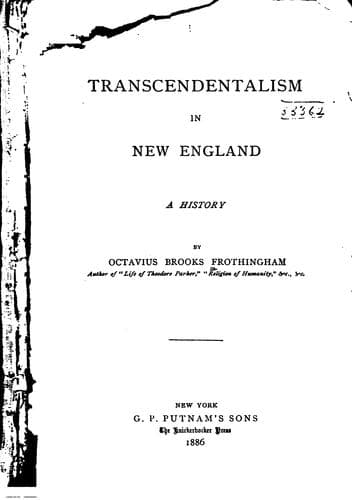
Transcendentalism in New England: A HistoryFrothingham, Octavius Brooks
Philosophy
Transcendentalism in New England: A History
Frothingham, Octavius Brooks
Transcendentalism (New England)
"Next to thinking for themselves, the best service any teacher can
render his scholars is to show them how to use books. The wise
teacher is the key for opening the mind to the books he places
before it."
"Stories are the idyls of childhood. They cast about it the romance
it loves and lives in, rendering the commonest circumstances and
things inviting and beautiful. Parables, poems, histories,
anecdotes, are prime aids in teaching; the readiest means of
influence and inspiration; the liveliest substitutes for flagging
spirits, fatigued wits."
"A little atlas of the body mythologically shown from the artist's
points of view, the plates displaying the person to the eye, in a
set of draped figures, is a book much wanted for first lines in
drawing. A child's piety is seen in its regards for its body and
the concern it shows in its carriage and keeping. Of all forms the
human form is most marvellous; and the modest reverence for its
shadings intimates the proper mode of studying it rightly and
religiously as a pantheon of powers. The prime training best opens
here as an idealism, the soul fashioning her image in the form she
animates, and so scrutinizing piously without plucking the
forbidden fruits."
"There is a want of suitable aids to the studies of these
mysteries. The best books I know are poor enough. In the want of a
better, we name for the study of matter in its connection with the
mind, including the proper considerations regarding health and
temperance, Graham's 'Laws of Life,' a rather dull but earnest
book; and for smaller classes and beginners Dr. Alcott's 'House I
Live In.' Miss Catherine Beecher's book for studies in Physiology
and Calisthenics, is a practical treatise, and should be in all
schools. Sir John Sinclair's 'Code of Health' contains a
republication of the Wisdom of the Ancients, on these subjects, and
is a book for all persons and times."
"Perhaps we are correcting the old affection for flogging at some
risk of spoiling the boys of this generation. Girls have always
known how to cover with shame any insult of that sort, but the
power of persuasion comes slow as a promptitude to supersede its
necessity. Who deals with a child, deals with a piece of divinity
obeying laws as innate as those he transgresses; and which he must
treat tenderly, lest he put spiritual interests in jeopardy.
Punishment must be just, else it cannot be accepted as good, and
least of all by the wicked and weak."
Public-domain text, read in full here on John Shaqi.
Reviews
Reviews
No reviews yet
Be the first to share your thoughts on this work.
Elsewhere in the archive
Join the Discussion
Join the discussion
Sign in to leave a comment or review.
Sign InorCreate an account