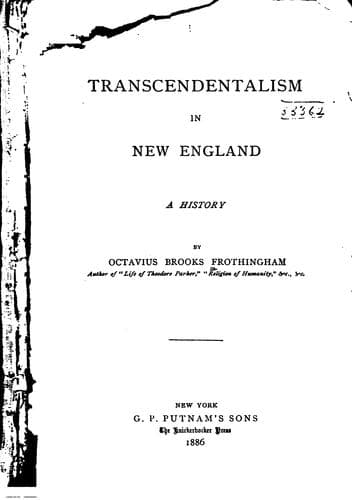
Transcendentalism in New England: A HistoryFrothingham, Octavius Brooks
Philosophy
Transcendentalism in New England: A History
Frothingham, Octavius Brooks
Transcendentalism (New England)
"It is difficult to reach the sources of ignorance and consequent
crime in a community like ours, calling itself free, and boasting
of its right to do what it will. But freedom is a social not less
than an individual concern, and the end of the State is to protect
it. The first object of a free people is the preservation of their
liberties. It becomes, then, their first duty to assume the
training of all the children in the principles of right knowledge
and virtue, as the only safeguard of their liberties. We cannot
afford to wait at such hazards. The simplest humanities are also
the least costly, and the nearest home. We should begin there. The
State is stabbed at the hearth-side and here liberty and honor are
first sold. It is injured by family neglect, and should protect
itself in securing its children's virtue against their parents'
vices; for, by so doing, can it alone redeem its pledges to
humanity and its citizens' liberties. A virtuous education is the
greatest alms it can bestow on any of its children."
Meetings for conversation with the parents of the scholars were a device
of Mr. Alcott for bringing the subject of education home to those whose
concern in it should be the deepest.
His faith was from the first in conversation, rather than in lecturing
or in preaching. Preaching assumed too much in the single mind, paid
less than due respect to the minds of the hearers, and gave no
opportunity for the instant exchange of thoughts. Lecturing was
intellectual and even less sympathetic. By conversation the best was
drawn out and the best imparted. All were put on an equality; all were
encouraged, none oppressed.
"Truth," Mr. Alcott declares "is spherical, and seen differently
according to the culture, temperament and disposition of those who
survey it from their individual standpoint. Of two or more sides,
none can be absolutely right, and conversation fails if it find not
the central truth from which all radiate; debate is angular,
conversation circular and radiant of the underlying unity. Who
speaks, deeply excludes all possibility of controversy. His
affirmation is self-sufficient; his assumption final, absolute.
Thus holding himself above the arena of dispute he gracefully
settles a question by speaking so home to the core of the matter as
to undermine the premise upon which an issue had been taken. For
whoso speaks to the personality dives beneath the grounds of
difference, and deals face to face with principles and ideas."
"Good discourse sinks differences and seeks agreements. It avoids
argument, by finding a common basis of agreement; and thus escapes
controversy by rendering it superfluous. Pertinent to the platform,
debate is out of place in the parlor. Persuasion is the better
weapon in this glittering game."
Public-domain text, read in full here on John Shaqi.
Reviews
Reviews
No reviews yet
Be the first to share your thoughts on this work.
Elsewhere in the archive
Join the Discussion
Join the discussion
Sign in to leave a comment or review.
Sign InorCreate an account