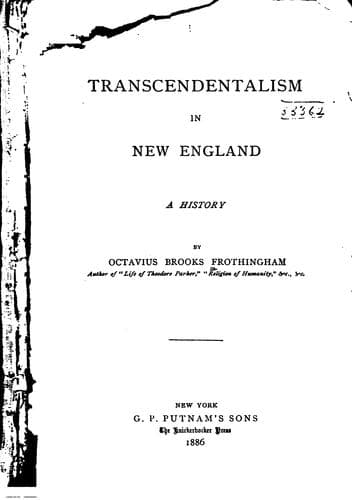
Transcendentalism in New England: A HistoryFrothingham, Octavius Brooks
Philosophy
Transcendentalism in New England: A History
Frothingham, Octavius Brooks
Transcendentalism (New England)
The tone of this extract is negatively transcendental; that is, it
implies that the writer did not belong to the opposite school, in any
sense; and that her mind was in condition to accept the cardinal truths
of a philosophy, the special doctrines whereof she did not apprehend or
feel interested in. Had she entertained a philosophical creed, it would
have been the creed of Schelling, more likely than any other.
Margaret Fuller was a critic, and a critic rather from natural gift than
from trained perception. Her genius was her guide. Persons and things
came to her for judgment, and judgment they received. Searching and
frank, but hearty and loving, she judged from the inside. To her, so her
biographers tell, with unanimous voice, "the secrets of all hearts were
revealed." In private intercourse, in letters, in parlor conversations
on books, pictures, statues, architecture, she was ever the judge. The
most unlike minds and characters receive their dues with entire
impartiality; Goethe, Lessing, Novalis, Jean Paul, were each in kind
honored. The last is "infinitely variegated, and certainly most
exquisitely colored, but fatigues attention; his philosophy and religion
seem to be of the sighing sort." She is steeped to the lips in enjoyment
by Southey, whom she was inclined to place next to Wordsworth.
Coleridge, Heine, Carlyle, Herschel, attract her mind. She ponders
before Michael Angelo's sibyls; displays a singular penetration in her
analysis of them, and makes them all interpreters of the genius of
woman. The soul of Greek art, as contrasted with Christian, is disclosed
to her with a clear perception; the Greek mythology gave up to her its
secret; emblems, symbols, dark parables, enigmas, mysteries, laid aside
their vails. A friend said of her: "She proceeds in her search after the
unity of things, the divine harmony, not by exclusion but by
comprehension; and so no poorest, saddest spirit but she will lead to
hope and faith. I have thought, sometimes, that her acceptance of evil
was _too_ great; that her theory of the good to be educed proved too
much; but I understand her now better than I did." Atkinson, the
"mesmeric atheist," struck her as "a fine instinctive nature, with a
head for Leonardo to paint," who "seems bound by no tie, yet looks as if
he had relatives in every place." Mazzini impressed her as one "in whom
holiness has purified, but somewhat dwarfed the man." Carlyle "is
arrogant and overbearing; but in his arrogance there is no bitterness,
no self-love. It is the heroic arrogance of some old Scandinavian
conqueror; it is his nature, and the untamable energy that has given him
power to crush the dragon." Dr. Wilkinson, the Swedenborgian, is "a
sane, strong, well-exercised mind; but in the last degree unpoetical in
its structure; very simple, natural, and good; excellent to see, though
one cannot go far with him." Rachel, Fourier, Rousseau--she has a
piercing glance for them all; a word of warm admiration, all the more
Public-domain text, read in full here on John Shaqi.
Reviews
Reviews
No reviews yet
Be the first to share your thoughts on this work.
Elsewhere in the archive
Join the Discussion
Join the discussion
Sign in to leave a comment or review.
Sign InorCreate an account