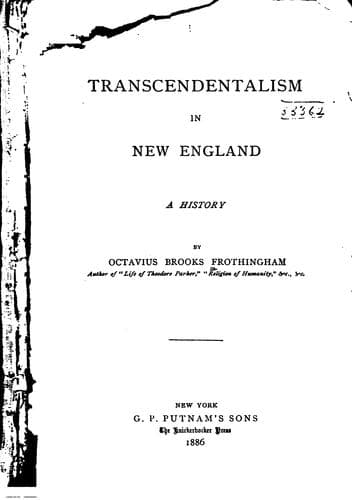
Transcendentalism in New England: A HistoryFrothingham, Octavius Brooks
Philosophy
Transcendentalism in New England: A History
Frothingham, Octavius Brooks
Transcendentalism (New England)
"When I was in Cambridge I got Fichte and Jacobi; I was much
interrupted, but some time and earnest thought I devoted; Fichte I
could not understand at all, though the treatise which I read was
one intended to be popular, and which he says must compel to
conviction. Jacobi I could understand in details, but not in
system. It seemed to me that his mind must have been moulded by
some other mind, with which I ought to be acquainted, in order to
know him well--perhaps Spinoza's. Since I came home I have been
consulting Buhle's and Tennemann's histories of philosophy, and
dipping into Brown, Stewart, and that class of books."
This was in 1832, before the transcendental movement began. At the same
period, writing to a friend on the subject of religious faith--a subject
intimately allied with philosophy--she said:
"I have not formed an opinion; I have determined not to form
settled opinions at present; loving or feeble natures need a
positive religion--a visible refuge, a protection--as much in the
passionate season of youth as in those stages nearer to the grave.
But mine is not such. My pride is superior to any feelings I have
yet experienced; my affection is strong admiration, not the
necessity of giving or receiving assistance or sympathy. When
disappointed, I do not ask or wish consolation; I wish to know and
feel my pain, to investigate its nature and its source; I will not
have my thoughts diverted or my feelings soothed; 'tis therefore
that my young life is so singularly barren of illusions. I know I
feel the time must come when this proud and impatient heart shall
be stilled, and turn from the ardors of search and action to lean
on something above. But shall I say it?--the thought of that calmer
era is to me a thought of deepest sadness; so remote from my
present being is that future existence, which still the mind may
conceive; I believe in eternal progression; I believe in a God, a
beauty and perfection, to which I am to strive all my life for
assimilation. From these two articles of belief I draw the rules by
which I strive to regulate my life; but though I reverence all
religions as necessary to the happiness of man, I am yet ignorant
of the religion of revelation. Tangible promises, well-defined
hopes, are things of which I do not _now_ feel the need. At
present, my soul is intent on this life, and I think of religion as
its rule; and in my opinion this is the natural and proper course
from youth to age."
Public-domain text, read in full here on John Shaqi.
Reviews
Reviews
No reviews yet
Be the first to share your thoughts on this work.
Elsewhere in the archive
Join the Discussion
Join the discussion
Sign in to leave a comment or review.
Sign InorCreate an account