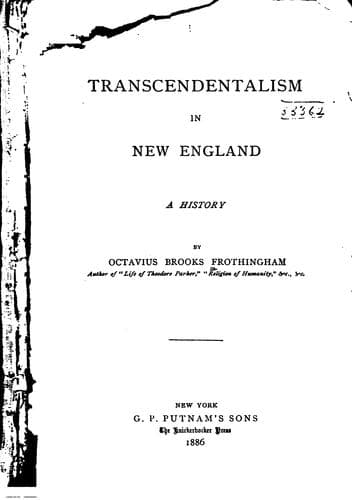
Transcendentalism in New England: A HistoryFrothingham, Octavius Brooks
Philosophy
Transcendentalism in New England: A History
Frothingham, Octavius Brooks
Transcendentalism (New England)
That these modest anticipations were justified and more, need not be
said. The "beautiful poesies" came, and so did the various, eloquent,
well-considered prose. The people who expected the whole gospel of
Transcendentalism may have been disappointed; for the editor gave the
magazine more of a literary than philosophical or reformatory tone. That
she looked for from others, and was more than willing to welcome. She
had a discerning eye for the evils of the time, and a sincere respect
for the men and women who were disposed to counteract them. Another
extract from her correspondence at this time--1840--taken, like the
former, from the second volume of the memoirs, leaves no doubt on this
point. After speaking of "the tendency of circumstances," since the
separation from England, "to make our people superficial, irreverent,
and more anxious to get a living than to live mentally and morally," she
continues:
"New England is now old enough, some there have leisure enough to
look at all this, and the consequence is a violent reaction, in a
small minority, against a mode of culture that rears such fruits.
They see that political freedom does not necessarily produce
liberality of mind, nor freedom in church institutions, vital
religion; and, seeing that these changes cannot be wrought from
without inwards, they are trying to quicken the soul, that they may
work from within outwards. Disgusted with the vulgarity of a
commercial aristocracy, they become radicals; disgusted with the
materialistic working of "rational" religion they become mystics.
They quarrel with all that is because it is not spiritual enough.
They would, perhaps, be patient, if they thought this the mere
sensuality of childhood in our nation, which it might outgrow; but
they think that they see the evil widening, deepening, not only
debasing the life, but corrupting the thought of our people; and
they feel that if they know not well what should be done, yet that
the duty of every good man is to utter a protest against what is
done amiss. Is this protest undiscriminating? Are these opinions
crude? Do these proceedings threaten to sap the bulwarks on which
men at present depend? I confess it all, yet I see in these men
promise of a better wisdom than in their opponents. Their hope for
man is grounded on his destiny as an immortal soul, and not as a
mere comfort-loving inhabitant of earth, or as a subscriber to the
social contract. It was not meant that the soul should cultivate
the earth, but that the earth should educate and maintain the soul.
Man is not made for society, but society is made for man. No
institution can be good which does not tend to improve the
individual. In these principles I have confidence so profound, that
I am not afraid to trust those who hold them, despite their partial
Public-domain text, read in full here on John Shaqi.
Reviews
Reviews
No reviews yet
Be the first to share your thoughts on this work.
Elsewhere in the archive
Join the Discussion
Join the discussion
Sign in to leave a comment or review.
Sign InorCreate an account