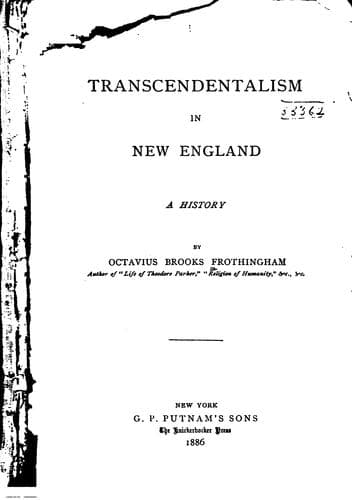
Transcendentalism in New England: A HistoryFrothingham, Octavius Brooks
Philosophy
Transcendentalism in New England: A History
Frothingham, Octavius Brooks
Transcendentalism (New England)
views, imperfectly developed characters, and frequent want of
practical sagacity. I believe, if they have opportunity to state
and discuss their opinions, they will gradually sift them,
ascertain their grounds and aims with clearness, and do the work
this country needs. I hope for them as for the 'leaven that is
hidden in the bushel of meal till all be leavened.' The leaven is
not good by itself, neither is the meal; let them combine, and we
shall yet have bread."
"Utopia it is impossible to build up; at least, my hopes for the
race on this one planet are more limited than those of most of my
friends; I accept the limitations of human nature, and believe a
wise acknowledgment of them one of the best conditions of progress;
yet every noble scheme, every poetic manifestation, prophesies to
man his eventual destiny; and were not man ever more sanguine than
facts at the moment justify, he would remain torpid, or be sunk in
sensuality. It is on this ground that I sympathize with what is
called the 'Transcendental Party,' and that I feel their aim to be
the true one. They acknowledge in the nature of man an arbiter for
his deeds--a standard transcending sense and time--and are, in my
view, the true utilitarians. They are but at the beginning of their
course, and will, I hope, learn to make use of the past, as well as
to aspire for the future, and to be true in the present moment."
Margaret Fuller's power lay in her faith in this spiritual capacity. The
confidence began with herself, and was extended to all others, without
exception. Mr. Channing says:
"Margaret cherished a trust in her powers, a confidence in her
destiny, and an ideal of her being, place and influence, so lofty
as to be extravagant. In the morning hour and mountain air of
aspiration, her shadow moved before her, of gigantic size, upon the
snow-white vapor."
Mr. Clarke says:
"Margaret's life _had an aim_, and she was, therefore, essentially
a moral person, and not merely an overflowing genius, in whom
impulse gives birth to impulse, deed to deed. This aim was
distinctly apprehended and steadily pursued by her from first to
last. It was a high, noble one, wholly religious, almost Christian.
It gave dignity to her whole career, and made it heroic.
"This aim, from first to last, was SELF-CULTURE. If she was ever
ambitious of knowledge and talent, as a means of excelling others,
and gaining fame, position, admiration--this vanity had passed
before I knew her, and was replaced by the profound desire for a
full development of her whole nature, by means of a full experience
of life."
Speaking of her demands on others, her three biographers agree that they
were based on the expectation in them of spiritual excellence:
Public-domain text, read in full here on John Shaqi.
Reviews
Reviews
No reviews yet
Be the first to share your thoughts on this work.
Elsewhere in the archive
Join the Discussion
Join the discussion
Sign in to leave a comment or review.
Sign InorCreate an account