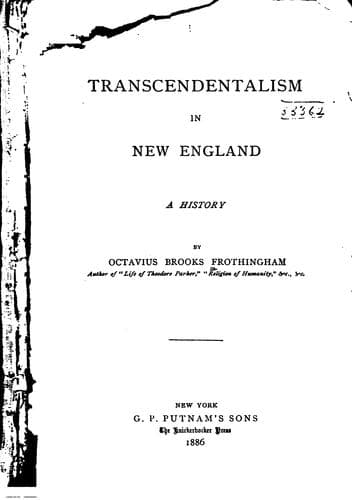
Transcendentalism in New England: A HistoryFrothingham, Octavius Brooks
Philosophy
Transcendentalism in New England: A History
Frothingham, Octavius Brooks
Transcendentalism (New England)
When the news of her death reached Boston, one of Boston's eminent men
in letters and public affairs quietly remarked: "it is just as well so."
He was thinking of the agitation she might cause by her brilliant
conversations and her lightning pen, if she brought back from her
Italian heroisms the high spirit of liberty. The times were growing dark
in America. The Slave Power was drawing its lines closer about the
citadel of freedom. The brave voices were few and fewer; the
conservatives were glad when one was hushed by death. The movement she
had encouraged was waning. The high enthusiasm was smouldering in
breasts that anticipated the battle which came ten years later. The
period of poetic aspiration and joy was ended, and the priestess, had
she survived, would have found a deserted shrine.
No accessible portrait of Margaret Fuller exists, that worthily presents
her. Thomas Hicks painted a likeness, of cabinet size, in Rome, which
her friends approved. The daguerreotype was too painfully literal to be
just; the sun having no sentiment or imagination in his eye. She was not
beautiful in youth, nor was she one of those who gain beauty with years.
Her physical attractions were of the kind that time impairs soon, and
though she died at forty, her personal charm was gone. Intellect gave
her what beauty she had, and they saw it who saw her intellect at play.
Her image, therefore, is best preserved in the memory of her friends.
They cannot put it on exhibition.
XII.
THE PREACHER.
Public-domain text, read in full here on John Shaqi.
Reviews
Reviews
No reviews yet
Be the first to share your thoughts on this work.
Elsewhere in the archive
Join the Discussion
Join the discussion
Sign in to leave a comment or review.
Sign InorCreate an account