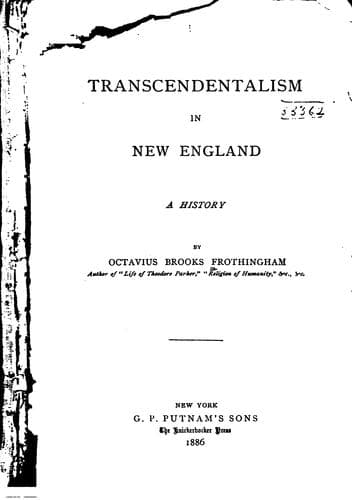
Transcendentalism in New England: A HistoryFrothingham, Octavius Brooks
Philosophy
Transcendentalism in New England: A History
Frothingham, Octavius Brooks
Transcendentalism (New England)
"She did not hesitate to avow that, on meeting some of these
abused, unhappy sisters, she had been surprised to find them
scarcely fallen morally below the ordinary standard of
womanhood,--realizing and loathing their debasement; anxious to
escape it; and only repelled by the sad consciousness that for them
sympathy and society remained only so long as they should persist
in the ways of pollution."
Margaret Fuller's loyalty to principles was proof against bad taste;
which is saying a good deal, for many a reformer is of opinion that
blunders are worse than crimes, and that vulgarity is more offensive
than wickedness. She found the Fourierites in Europe terribly wearisome,
and yet did not forget that they served the great future which neither
they nor she would live to see. At home she could not endure the
Abolitionists--"they were so tedious, often so narrow, always so rabid
and exaggerated in their tone. But, after all, they had a high motive,
something eternal in their desire and life; and if it was not the only
thing worth thinking of, it was really something worth living and dying
for, to free a great nation from such a blot, such a plague." In Europe
she was disgusted at hearing Americans urging the same arguments against
the freedom of the Italians that they urged at home against the
emancipation of the blacks; the same arguments in favor of the
spoliation of Poland that they used at home in favor of the conquest of
Mexico. With her, principles were independent of time and place. She
always believed in liberty as a condition of enlightenment, and in
enlightenment as a condition of progress. This practical faith in the
intellectual and moral nature is the key to all her work. Every chamber
that opened she entered and occupied, fearless of ghosts and goblins.
The chambers that opened not she was content to leave unopened
altogether.
On the table where the writer pens this poor tribute to a most
remarkable woman, are the bulky volumes of her unpublished letters and
diaries, revealing some things too personal for the public eye, but
nothing in the least incongruous with the best things recorded by her
biographers and suggested here; and how much they tell that illustrates
and confirms the moral nobleness and sweetness of her nature. They
contain a psychometric examination from two letters, given after the
manner familiar to those interested in such things, by one of the chief
of these spiritual vaticinators. We shall not transcribe it, for it is
long and indistinct. The indistinctness is the one interesting feature
of the sketch. The sensitive reporter confessed herself put out by the
singular commingling of moods and dispositions, and seemed to be
describing several persons in one. But through them all the same general
impression was clear; the impression of a fascinating, lovable, earnest
and lofty spirit, which, whether sad or gay, intellectual or
sentimental, bore itself like a queenly woman.
Public-domain text, read in full here on John Shaqi.
Reviews
Reviews
No reviews yet
Be the first to share your thoughts on this work.
Elsewhere in the archive
Join the Discussion
Join the discussion
Sign in to leave a comment or review.
Sign InorCreate an account