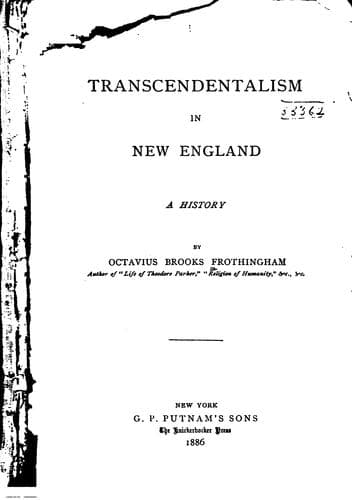
Transcendentalism in New England: A HistoryFrothingham, Octavius Brooks
Philosophy
Transcendentalism in New England: A History
Frothingham, Octavius Brooks
Transcendentalism (New England)
The explanation is easy; Transcendentalism possessed all the chief
qualifications for a gospel. Its cardinal "facts" were few and
manageable. Its data were secluded in the recesses of consciousness, out
of the reach of scientific investigation, remote from the gaze of vulgar
skepticism; esoteric, having about them the charm of a sacred privacy,
on which common sense and the critical understanding might not intrude.
Its oracles proceeded from a shrine, and were delivered by a priest or
priestess, who came forth from an interior holy of holies to utter them,
and thus were invested with the air of authority which belongs to
exclusive and privileged truths, that revealed themselves to minds of a
contemplative cast. It dealt entirely with "divine things," "eternal
realities;" supersensible forms of thought; problems that lay out of the
reach of observation, such as the essential cause, spiritual laws, the
life after death, the essence of the good, the beautiful, the true; the
ideal possibilities of the soul; its organ was intuition; its method was
introspection: its brightness was inspiration. It possessed the
character of indefiniteness and mystery, full of sentiment and
suggestion, that fascinates the imagination, and lends itself so easily
to acts of contemplation and worship. The German Mystics were in spirit
Transcendentalists. The analogies are close between Boehme and
Schelling; between Eckardt and Fichte; Frederick Schlegel had much in
common with Boehme; Coleridge acknowledged his debt to him and to other
Mystics; even Hegel ran in line with them on some of his high roads.
Minds as opposite as Alcott and Parker met in communion here--Alcott
going to the Mystics for inspiration; Parker resorting to them for rest.
The Mystics were men of feeling; the Transcendentalists were men of
thought: but thought and feeling sought the same object in the same
region. Piety was a feature of Transcendentalism; it loved devout hymns,
music, the glowing language of aspiration, the moods of awe and
humility, emblems, symbols, expressions of inarticulate emotion,
silence, contemplation, breathings after communion with the Infinite.
The poetry of Transcendentalism is religious, with scarcely an
exception; the most beautiful hymns in our sacred collections, the only
deeply impressive hymns, are by transcendental writers.
Public-domain text, read in full here on John Shaqi.
Reviews
Reviews
No reviews yet
Be the first to share your thoughts on this work.
Elsewhere in the archive
Join the Discussion
Join the discussion
Sign in to leave a comment or review.
Sign InorCreate an account