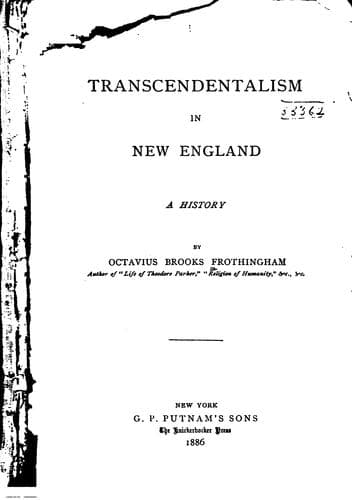
Transcendentalism in New England: A HistoryFrothingham, Octavius Brooks
Philosophy
Transcendentalism in New England: A History
Frothingham, Octavius Brooks
Transcendentalism (New England)
This was the aspect of Transcendentalism that fascinated Theodore
Parker. His intellect was constructed on the English model. His acute
observation; his passion for external facts; his faith in statistics;
his hunger for information on all external topics of history and
politics; his capacity for retaining details of miscellaneous knowledge;
his logical method of reasoning; his ability to handle masses of raw
mental material, to distribute and classify;--all indicate intellectual
power of the English rather than of the German type. It was his custom
to speak slightingly of the "Bridgewater Treatises" and works of a
similar class, in which the processes of inductive argument are employed
to establish truths of the "Pure Reason;" but he easily fell into the
same habit, and pushed the inductive method as far as it would go. His
discourses on Providence, the Economy of Pain and Misery, Atheism,
Theism, in the volume entitled "Theism, Atheism, and The Popular
Theology," are quite in the style of the "Bridgewater Treatises." Parker
was, in many respects, the opposite of a Mystic; he was a realist of the
most concrete description, entirely at home among sensible things, a
good administrator, a safe investor of moneys, a wise counsellor in
practical affairs. But along with this intellectual quality which he
inherited from his father, was an interior, sentimental, devotional
quality, derived from his mother. The two were never wholly blended;
often they were wide apart, occupying different spheres, and engaged in
different offices; sometimes they were in apparent opposition. Neither
could subdue or overshadow the other; neither could keep the other long
in abeyance. As a rule, the dominion was divided between them: the
practical understanding assumed control of all matters pertaining to
this world; the higher reason claimed supremacy in all matters of
faith. But for the tendency to poetic idealism, which came to him from
his mother, Parker might, from the constitution of his mind, have
belonged to an opposite school. A passage in the letter from Santa Cruz,
entitled "Theodore Parker's Experience as a Minister," is curious, as
showing how the two tendencies of his mind overlapped; he is speaking of
the two methods of developing the contents "of the instinctive
intuitions of the divine, the just, and the immortal,"--the inductive
and the deductive. After a few words respecting the inductive method of
gathering facts from the history of mankind, he speaks thus of the
deductive: "Next, from the primitive facts of consciousness given by the
power of instinctive intuition, I endeavored to deduce the true notion
of God, of justice, and futurity." Then, forgetting that the power of
instinctive intuition must be self-authenticating--cannot, at any rate,
be authenticated by miscellaneous facts in the religious history of
mankind--he continues:
Public-domain text, read in full here on John Shaqi.
Reviews
Reviews
No reviews yet
Be the first to share your thoughts on this work.
Elsewhere in the archive
Join the Discussion
Join the discussion
Sign in to leave a comment or review.
Sign InorCreate an account