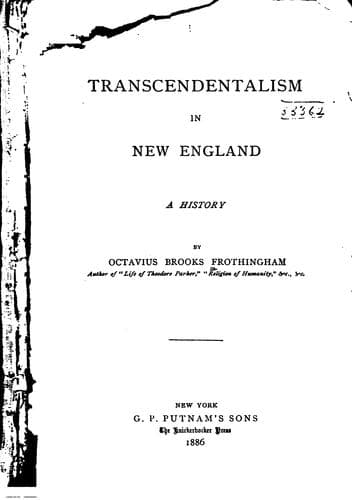
Transcendentalism in New England: A HistoryFrothingham, Octavius Brooks
Philosophy
Transcendentalism in New England: A History
Frothingham, Octavius Brooks
Transcendentalism (New England)
"Then it was declared that I was a shrewd, practical man, perfectly
well 'posted up' in every thing that took place; knew how to make
investments and get very large returns,--unluckily it has not been
for myself that this has been true. And it was said that I
collected large headed, practical men to hear me, and that you were
a 'boisterous assembly.'
"Then, that I was a learned man and gave learned discourses on
ecclesiastical history or political history,--things which have not
been found very attractive in the churches hitherto.
"Again, that I was a philosopher, with a wise head, and taught men
theological metaphysics; and so a large company of men seemed all
at once smitten with a panic for metaphysics and abstract
preaching. It was never so before.
"Next it was reported that I was a witty man, and shot nicely
feathered arrows very deftly into the mark; and that men came to
attend the sharp shooting of a wit.
"Then there was a seventh thing,--that I was an eloquent man; and I
remember certain diatribes against the folly of filling churches
with eloquence.
"Then again, it was charged against me that I was a philanthropist,
and taught the love of men, but did not teach at all the love of
God; and that men really loved to love one another, and so came.
"Then it was thought that I was a sentimentalist, and tickled the
ears of 'weak women,' who came to delight themselves and be filled
full of poetry and love.
"The real thing they did not seem to hit; that I preached an idea
of God, of man and of religion, which commended itself to the
nature of mankind."
The great preacher is always an idealist, and according to the fervor of
his idealism is he great. This was the source of Channing's power; it
was the charm of Emerson's. In reply to a friend who questioned her as
to the nature of the benefits conferred on her by Mr. Emerson's
preaching, Margaret Fuller wrote:
"His influence has been more beneficial to me than that of any
American, and from him I first learned what is meant by an inward
life. Many other springs have since fed the stream of living
waters, but he first opened the fountain. That the 'mind is its own
place' was a dead phrase to me till he cast light upon my mind.
Several of his sermons stand apart in memory, like landmarks of my
spiritual history. It would take a volume to tell what this one
influence did for me."
Public-domain text, read in full here on John Shaqi.
Reviews
Reviews
No reviews yet
Be the first to share your thoughts on this work.
Elsewhere in the archive
Join the Discussion
Join the discussion
Sign in to leave a comment or review.
Sign InorCreate an account