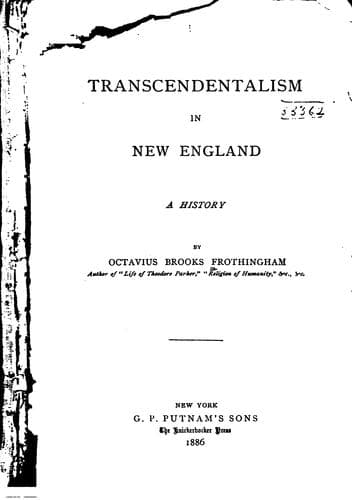
Transcendentalism in New England: A HistoryFrothingham, Octavius Brooks
Philosophy
Transcendentalism in New England: A History
Frothingham, Octavius Brooks
Transcendentalism (New England)
righteousness was betrayed into intemperance of zeal, peace made haste
to offer its kiss of sorrow, and unaffected tears damped down the flames
of wrath when they threatened to consume the innocent. This two-fold
power of blasting and of blessing, was vastly effective both on large
audiences and on small. The personal integrity which no one ever
doubted, the courage which was evident to even hasty observers, the
mental independence which justified the boldness of its position by an
indefatigable purpose to discover truth, were prime qualifications for
the office he filled. The very disadvantages,--an unheroic presence, an
uninspired countenance, an unmelodious and unpliable voice, the
necessity of interposing glasses between his clear blue eyes and his
audience, and thus veiling the heavens that lay behind them,--helped him
by putting out of mind all thought of meretricious attempts at
influence, and compelling recognition of the intellectual and moral
force which could so easily dispense with what most orators consider
invaluable aids.
All that Parker had went into his preaching; the wealth of his library,
the treasures of his heart, the sweetness of his closet meditations, the
solemnity of his lonely musings. But it was not this that gave him his
great power as a preacher. That, we are persuaded, was due in chief part
to the earnestness of his faith in the transcendental philosophy. How
cordially he entertained that faith, what to him it signified in
politics, ethics, religion, may be learned by any who will take pains to
read a lecture by him on Transcendentalism, recently published by the
Free Religious Association. That he ascribed the popular interest in his
preaching to his philosophical ideas will not perhaps be accepted as
evidence on the point, for men are apt to be mistaken in regard to the
sources of their power; but it is interesting as a testimony to his own
belief, to know that he did so. In a sermon preached on November 14th,
1852, the occasion being his leaving the Melodeon for the Music Hall, he
presents first the current modes of accounting for his success, and
then his own.
"The first reason assigned for the audience coming together was
this: they came from vain curiosity, having itching ears to hear
'what this babbler sayeth.'
"Then it was said, men came here because I taught utter irreligion,
blank immorality; that I had no love of God, no fear of God, no
love of man; and that you thought, if you could get rid of your
conscience and soul, and trample immortality under foot, and were
satisfied there was no God, you should have a very nice time of it
here and hereafter.
Public-domain text, read in full here on John Shaqi.
Reviews
Reviews
No reviews yet
Be the first to share your thoughts on this work.
Elsewhere in the archive
Join the Discussion
Join the discussion
Sign in to leave a comment or review.
Sign InorCreate an account