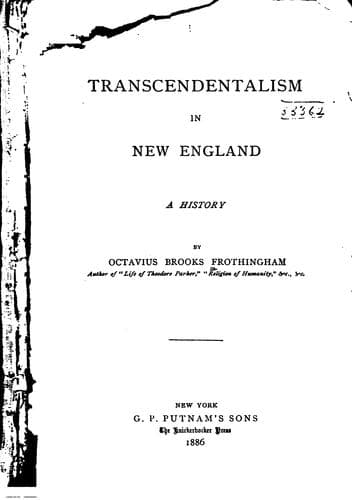
Transcendentalism in New England: A HistoryFrothingham, Octavius Brooks
Philosophy
Transcendentalism in New England: A History
Frothingham, Octavius Brooks
Transcendentalism (New England)
"If to-morrow I am to perish utterly, then I shall only take
counsel for to-day, and ask for qualities which last no longer. My
fathers will be to me only as the ground out of which my bread-corn
is grown; dead, they are like the rotten mould of earth, their
memory of small concern to me. Posterity--I shall care nothing for
the future generations of mankind. I am one atom in the trunk of a
tree, and care nothing for the roots below or the branches above; I
shall sow such seed as will bear harvest to-day; I shall know no
higher law; passion enacts my statutes to-day; to-morrow ambition
revises the statutes, and these are my sole legislators; morality
will vanish, expediency take its place; heroism will be gone, and
instead of it there will be the brute valor of the he-wolf, the
brute-cunning of the she-fox, the rapacity of the vulture, and the
headlong daring of the wild bull; but the cool, calm courage which,
for truth's sake, and for love's sake, looks death firmly in the
face, and then wheels into line, ready to be slain--that will be a
thing no longer heard of."
"The atheist sits down beside the coffin of his only child--a
rose-bud daughter, whose heart death slowly ate away; the pale
lilies of the valley which droop with fragrance above that lifeless
heart, are flowers of mockery to him, their beauty is a cheat; they
give not back his child, for whom the sepulchral monster opens his
remorseless jaws. The hopeless father looks down on the face of his
girl, silent--not sleeping, cold--dead.... He looks beyond--the
poor sad man--it is only solid darkness he looks on; no rainbow
beautifies that cloud; there is thunder in it, not light; night is
behind--without a star."
This is the way the Protestant Christians spoke of him; the
"Evangelicals" spoke thus of the Unitarians; the believers in miraculous
revelations spoke thus of the rationalists. They that are sure always
speak so of those who, in their judgment, have no right to be sure at
all.
Public-domain text, read in full here on John Shaqi.
Reviews
Reviews
No reviews yet
Be the first to share your thoughts on this work.
Elsewhere in the archive
Join the Discussion
Join the discussion
Sign in to leave a comment or review.
Sign InorCreate an account