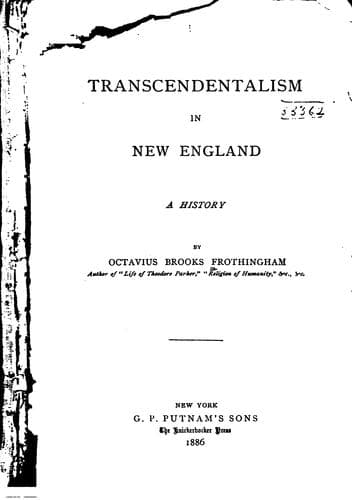
Transcendentalism in New England: A HistoryFrothingham, Octavius Brooks
Philosophy
Transcendentalism in New England: A History
Frothingham, Octavius Brooks
Transcendentalism (New England)
Yet Parker had a hospitable mind, and his hospitality was due also to
his faith. The spiritual philosophy which maintained the identity in all
men of consciousness, and the eternal validity of its promises, which no
error or petulance could discredit, was indulgent to the unfortunates
who had not the satisfaction of its assurance. It pitied, but did not
reproach them. They were children of God no less for being ignorant of
their dignity. It was impossible for Parker to believe that rational
beings could be utterly insensible to the essential facts of their own
nature. Their error, misconception, misconstruction, to whatever cause
due, could be no more than incidental. Skepticism might make wild work
of definitions, but ultimate facts it could never disturb; these would
thrust themselves up at last, as inevitably as the rocky substratum of
the globe presents itself in the green field. In a thanksgiving sermon
he thanked God that atheism could freely deliver its creed and prove
that it was folly. He was persuaded that the disbelievers believed
better than they knew; in their paroxysms of denial, he saw the blind
struggles of faith; he gave the enemies of religion credit for qualities
that made their hostility look like a heroic protest against the
outrages inflicted in the name of religion upon religion itself.
"It is a fact of history, that in old time, from Epicurus to
Seneca, some of the ablest heads and best hearts of Greece and Rome
sought to destroy the idea of immortality. This was the reason:
they saw it was a torment to mankind; that the popular notion of
immortality was too bad to be true; and so they took pains to break
down the Heathen Mythology, though with it they destroyed the
notion of immortal life. They did a great service to mankind in
ridding us from this yoke of fear.
"Many a philosopher has seemed without religion, even to a careful
observer--sometimes has passed for an atheist. Some of them have to
themselves seemed without any religion, and have denied that there
was any God; but all the while their nature was truer than their
will; their instinct kept their personal wholeness better than they
were aware. These men loved absolute truth, not for its uses, but
for itself; they laid down their lives for it, rather than violate
the integrity of their intellect. They had the intellectual love of
God, though they knew it not, though they denied it.
"I have known philanthropists who undervalued piety; they liked it
not--they said it was moonshine, not broad day; it gave flashes of
lightning, all of which would not make light.... Yet underneath
their philanthropy there lay the absolute and disinterested love of
other men. They knew only the special form, not the universal
substance thereof.
Public-domain text, read in full here on John Shaqi.
Reviews
Reviews
No reviews yet
Be the first to share your thoughts on this work.
Elsewhere in the archive
Join the Discussion
Join the discussion
Sign in to leave a comment or review.
Sign InorCreate an account