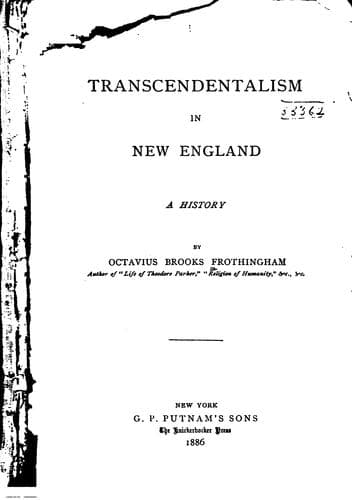
Transcendentalism in New England: A HistoryFrothingham, Octavius Brooks
Philosophy
Transcendentalism in New England: A History
Frothingham, Octavius Brooks
Transcendentalism (New England)
The character of that Association has been described in a previous
chapter, with as much minuteness of detail as is necessary, and the
purposes of its inaugurators have been sufficiently indicated. The
founder of it was not a "doctrinaire," but a philanthropist on ideal
principles. With the systems of socialism current in Paris, he was at
that period wholly unacquainted. The name of Charles Fourier was
unfamiliar to him. He had faith in the soul, and in the soul's prophecy
of good; he saw that the prophecy was unheeded, that society rested on
principles which the soul abhorred; that between the visions of the
spiritual philosophy and the bitter realities of vice, misery, sin, in
human life, there was an unappeasable conflict; and he was resolved to
do what one man might to create a new earth in preparation for a new
heaven. He took the Gospel at its word, and went forth to demonstrate
the power of its principles, by showing the Beatitudes to be something
more substantial than dreams. His costly library, with all its beloved
books, was offered for sale at public auction, and the price thereof,
with whatever else he possessed, was consecrated to the cause of
humanity that he had at heart. He had no children, and few ties of
kindred; but the social position of the clergy was above any secular
position in New England at that time; the prejudices and antipathies of
the clerical order were stubborn; the leaders of opinion in state and
church were conservative, to a degree it is difficult for us to believe;
the path of the reformer was strewn with thorns and beset with
difficulties most formidable to sensitive spirits. Mr. Emerson had
resigned his ministry nine years before, and for the reason too that he
was a Transcendentalist, but had retired to the peaceful walks of
literature, and had made no actual assault on social institutions. Mr.
Ripley associated himself at once with people of no worldly
consideration, avowed principles that were voted vulgar in refined
circles, and identified himself with an enterprise which the amiable
called visionary, and the unamiable wild and revolutionary. But his
conviction was clear, and his will was fixed. Sustained by the entire
sympathy of a very noble woman, his wife--who was one with him in
aspiration, purpose, and endeavor, till the undertaking ended--he put
"the world" behind him, sold all, and followed the Master.
Public-domain text, read in full here on John Shaqi.
Reviews
Reviews
No reviews yet
Be the first to share your thoughts on this work.
Elsewhere in the archive
Join the Discussion
Join the discussion
Sign in to leave a comment or review.
Sign InorCreate an account