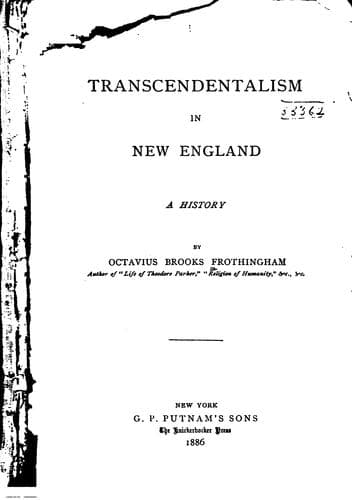
Transcendentalism in New England: A HistoryFrothingham, Octavius Brooks
Philosophy
Transcendentalism in New England: A History
Frothingham, Octavius Brooks
Transcendentalism (New England)
Mr. Ripley prepared for the ministry at the Cambridge divinity school;
in 1826 accepted a call to be pastor and preacher of the church,
organized but eighteen months before, and within two months worshipping
in their new meeting-house on Purchase street, Boston. The ordination
took place on Wednesday, Nov. 8th, of the same year. "Under his
charge," said his successor, Rev. J. I. T. Coolidge, in 1848, "the
society grew from very small beginnings to strength and prosperity. As a
preacher, he awakened the deepest interest, and as a devoted pastor, the
warmest affection, which still survives, deep and strong, in the hearts
of those who were the objects of his counsel and pastoral care. After
the lapse of almost fifteen years, the connection was dissolved, for
reasons which affected not the least the relations of friendship and
mutual respect between the parties. It has been a great satisfaction to
me, as I have passed in and out among you, to hear again and again the
expressions of love and interest with which you remember the ministry of
your first servant in this church." That this was not merely the formal
tribute which the courtesies of the profession exacted, is proved, as
well as such a thing can be proved, by the published correspondence
between the pastor and his people, by the frank declarations of the
pastor in his farewell address, and by a remarkable letter, which
discussed in full the causes that led to the separation of the pastor
and his flock. In this long and candid letter to the church, Mr. Ripley
declared himself a Transcendentalist, and avowed his sympathy with
movements larger than the Christian Church represented.
The declaration was hardly necessary. Mr. Ripley was known to be the
writer of the review of Martineau's "Rationale of Religious Enquiry,"
which raised such heated controversy; his translation of Cousin's
"Philosophical Miscellanies," with its important Introduction, had
attracted the attention of literary circles; a volume of discourses,
entitled "Discourses on the Philosophy of Religion," comprising seven
sermons delivered in the regular course of his ministry, left no doubt
in any mind respecting his position. The controversy with Andrews Norton
on "The Latest Form of Infidelity," was carried on in 1840, the year
before Mr. Ripley's ministry ended. The calmness of tone that
characterized all these writings, the clearness and serenity of
statement, the seemingly easy avoidance of extremes, the absence of
passion, showed the supremacy of intellect over feeling. Yet of feeling
there must have been a good deal. There was a great deal in the
community; there was a great deal among the clergy of his denomination;
that it had found expression within his own society, is betrayed in the
farewell sermon; that his own heart was deeply touched, was confessed by
the fact that on the very day after his parting words to his
congregation were spoken--on March 29th, 1841--Mr. Ripley took up his
new ministry at Brook Farm.
Public-domain text, read in full here on John Shaqi.
Reviews
Reviews
No reviews yet
Be the first to share your thoughts on this work.
Elsewhere in the archive
Join the Discussion
Join the discussion
Sign in to leave a comment or review.
Sign InorCreate an account