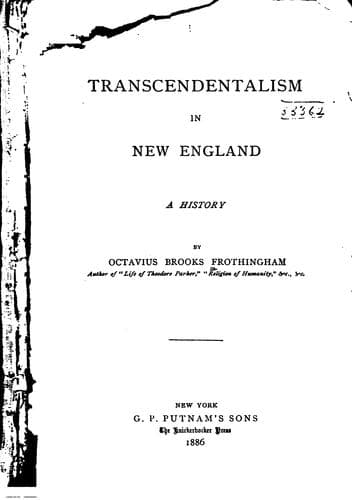
Transcendentalism in New England: A HistoryFrothingham, Octavius Brooks
Philosophy
Transcendentalism in New England: A History
Frothingham, Octavius Brooks
Transcendentalism (New England)
"The interests of Social Reform will be considered as paramount to
all others in whatever is admitted into the pages of the
"Harbinger." We shall suffer no attachment to literature, no taste
for abstract discussion, no love of purely intellectual theories,
to seduce us from our devotion to the cause of the oppressed, the
down trodden, the insulted and injured masses of our fellow men.
Every pulsation of our being vibrates in sympathy with the wrongs
of the toiling millions; and every wise effort for their speedy
enfranchisement will find in us resolute and indomitable advocates.
If any imagine from the literary tone of the preceding remarks that
we are indifferent to the radical movement for the benefit of the
masses which is the crowning glory of the nineteenth century, they
will soon discover their egregious mistake. To that movement,
consecrated by religious principle, sustained by an awful sense of
justice, and cheered by the brightest hopes of future good, all our
powers, talents, and attainments are devoted. We look for an
audience among the refined and educated circles, to which the
character of our paper will win its way; but we shall also be read
by the swart and sweaty artisan; the laborer will find in us
another champion; and many hearts struggling with the secret hope
which no weight of care and toil can entirely suppress, will pour
on us their benedictions, as we labor for the equal rights of all."
In the four years of its existence, the paper was faithful to this grand
and high sounding promise. A powerful company of writers contributed
their labor to help forward the plan. The Journal was affluent and
sparkling. The literary criticism was the work of able pens; the musical
and art criticism was in the hands of the most competent judges in the
country; the æsthetics were not neglected; the verse was excellent; but
the social questions were of first consideration. These were never
treated slightingly, and the treatment of them never deviated from the
high standard proposed by the editors. The list of its contributors
contained the names of Stephen Pearl Andrews, Albert Brisbane, W. H.
Channing, W. E. Channing, Walter Channing, James Freeman Clarke, Geo. H.
Calvert, J. J. Cooke, A. J. H. Duganne, C. P. Cranch, Geo. W. Curtis,
Charles A. Dana, J. S. Dwight, Horace Greeley, Parke Godwin, F. H.
Hedge, T. W. Higginson, M. E. Lazarus, J. R. Lowell, Osborn Macdaniel,
Geo. Ripley, S. D. Robbins, L. W. Ryckman, F. G. Shaw, W. W. Story,
Henry James, John G. Whittier, J. J. G. Wilkinson--a most remarkable
collection of powerful names.
Public-domain text, read in full here on John Shaqi.
Reviews
Reviews
No reviews yet
Be the first to share your thoughts on this work.
Elsewhere in the archive
Join the Discussion
Join the discussion
Sign in to leave a comment or review.
Sign InorCreate an account