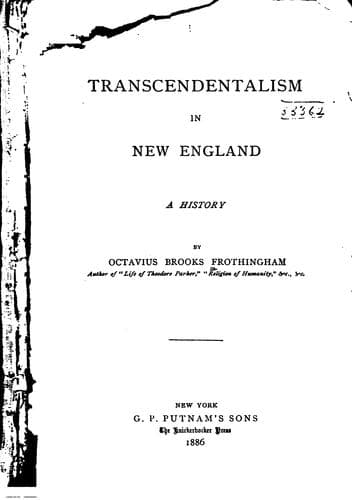
Transcendentalism in New England: A HistoryFrothingham, Octavius Brooks
Philosophy
Transcendentalism in New England: A History
Frothingham, Octavius Brooks
Transcendentalism (New England)
The departments seem not to have been systematically arranged, but the
writers sent what they had, the same writer furnishing articles on a
variety of topics. Mr. F. G. Shaw published, in successive numbers, an
admirable translation of George Sand's "Consuelo," and wrote against the
iniquities of the principle of competition in trade. C. A. Dana noticed
books, reported movements, criticized men and measures, translated
poetry from the German, and sent verses of a mystical and sentimental
character of his own. C. P. Cranch contributed poems and criticisms on
art and music. J. S. Dwight paid attention to the musical department,
but also wrote book reviews and articles on the social problem. W. H.
Channing poured out his burning soul in denunciation of social wrong and
painted in glowing colors the promise of the future. G. W. Curtis sent
poetry and notes on literature and music in New York. T. W. Higginson
printed there his "Hymn of Humanity." Messrs. Brisbane, Godwin and
Greeley confined themselves to social problems, doing a large part of
the heavy work. Mr. Ripley, the Managing Editor, supervised the whole;
wrote much himself on the different aspects of Association; reported the
progress of the cause at home and abroad; answered the objections that
were current in the popular prejudice, and gave to the paper the
encouraging tone of his cheery, earnest spirit.
As interpreted by the "Harbinger," the cause of Association was
hospitable and humane. The technicalities of special systems were
avoided; dry discussions of theory and method were put aside; generous
sympathy was shown towards philanthropic workers in other fields; the
tone of wailing was never heard, and the anticipations of the future
were steadily bright and bold. When reformers of a pronounced type, like
the abolitionists, spoke of it slightingly as a "kid glove" journal that
was afraid of soiling its fingers with ugly matters like slavery, the
Associationists explained that their plan was the more comprehensive;
that they struck at the root of every kind of slavery; and that the
worst evils would disappear when their beneficent principle should be
recognized. That the "Harbinger" should have lived no longer than it
did, with such a corps of writers and so great a cause,--the last number
is dated February 10, 1849,--may be accounted for by the feeble hold
that Socialism had in this country. In Europe the hearts of the working
people were in it. It originated among them, expressed their actual
sorrows, answered their living questions, promised satisfaction to their
wants, and predicted the only future they could imagine as in any way
possible. Here it was an imported speculation; the working people were
not driven to it for refuge from their misery; they did not ask the
questions it proposed to answer, nor did it hold out prospects that
gladdened their eyes. The advocates of it were cultivated men, literary
and æsthetical, who represented the best the old world had to give,
Public-domain text, read in full here on John Shaqi.
Reviews
Reviews
No reviews yet
Be the first to share your thoughts on this work.
Elsewhere in the archive
Join the Discussion
Join the discussion
Sign in to leave a comment or review.
Sign InorCreate an account