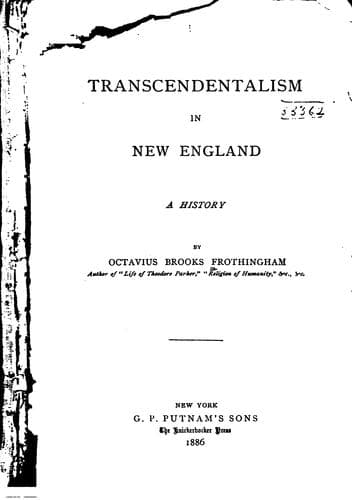
Transcendentalism in New England: A HistoryFrothingham, Octavius Brooks
Philosophy
Transcendentalism in New England: A History
Frothingham, Octavius Brooks
Transcendentalism (New England)
James Freeman Clarke as little deserves to be ranked among the Minor
Prophets as any, for he was one of the earliest Transcendentalists, a
contemporary and intimate ally of Parker, a co-worker with Channing, a
close friend and correspondent of Miss Fuller, a sympathizer with Alcott
in his attempts to spiritualize education, a frequent contributor to the
"Dial," the intellectual fellow of the brilliant minds that made the
epoch what it was. But his interest was not confined to the school, nor
did the technicalities or details of the transcendental movement
embarrass him; his catholic mind took in opinions of all shades, and men
of all communions. His place is among theologians and divines rather
than among philosophers. But, though churchly tastes led him away from
the company of thinkers where he intellectually belonged, and an
unfailing common sense saved him from the extravagances into which some
of them fell, a Transcendentalist he was, and an uncompromising one. The
intuitive philosophy was his guide. It gave him his assurance of
spiritual truths; it interpreted for him the gospels and Jesus; it
inspired his endeavors to reconcile beliefs, to promote unity among the
discordant sects, to enlighten and redeem mankind. His mission has been
that of a spiritual peace-maker. But while doing this, he has worked
faithfully at particular causes; was an avowed and earnest abolitionist
in the anti-slavery days; was ever a disbeliever in war, an enemy of
vindictive and violent legislation, a hearty friend and laborer in the
field of woman's election to the full privileges of culture and
citizenship; a man in whom faith, hope and charity abounded and abound;
a man of intellectual convictions which made a groundwork for his life.
Mr. Clarke is a conspicuous example of the way in which the intuitive
philosophy leavened the whole mind. It associated him closely both with
radicals and conservatives; with the former, because his principle
involved faith in progress; with the latter, because it implied respect
for the progress of past times which institutions preserved. His
conservatism attested the fidelity of his radicalism, and both avouched
the loyalty of his idealism. The conservative aspect of
Transcendentalism which was exhibited in the case of Mr. Channing, who
never left the Christian Church, was yet more strikingly illustrated by
Mr. Clarke. All his books, but particularly the "Ten Great Religions,"
show the power of the transcendental idea to render justice to all forms
of faith, and give positive interpretations to doctrines obscure and
revolting. It detects the truth in things erroneous, the good in things
evil.
Public-domain text, read in full here on John Shaqi.
Reviews
Reviews
No reviews yet
Be the first to share your thoughts on this work.
Elsewhere in the archive
Join the Discussion
Join the discussion
Sign in to leave a comment or review.
Sign InorCreate an account