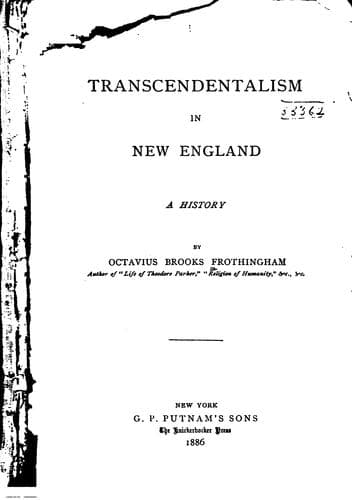
Transcendentalism in New England: A HistoryFrothingham, Octavius Brooks
Philosophy
Transcendentalism in New England: A History
Frothingham, Octavius Brooks
Transcendentalism (New England)
Mr. Johnson came forward when the excitement of transcendentalism was
passing by; the "Dial" no longer marked the intellectual hours; the
Unitarian controversy had spent its violence. It was in part owing to
this, but more to the spiritual character of his genius, that his
Transcendentalism was free from polemic and dogmatic elements; but it
was none the less positive and definite for that--if anything, it was
more so. In the divinity school he was an ardent disciple of the
intuitive philosophy. On leaving Cambridge he became an independent
minister of the most pronounced views, but of most reverent spirit; a
"fideist" or faith man, he loved to call himself; his aim and effort was
to awaken the spiritual nature, to interpret the spiritual philosophy,
and to apply the spiritual laws to all personal, domestic and social
concerns. Like all the Transcendentalists, he was a reformer, and an
enthusiastic one; interested in liberty and progress, but primarily in
intellectual emancipation and the increase of rational ideas. The
alteration of the lot was incidental to the regeneration of the person.
So absolute is his faith in the soul that he renders poetic justice to
its manifestations, seeing indications of its presence where others see
none, and glorifying where others are inclined to pity. The ideal side
is never turned away from him. He discerned the angel in the native
African, the saint in the slave, the devotee in the idolater. During the
civil war, his faith in the triumph of justice and the establishment of
a pure republic, converted every defeat into a victory; as in the vision
of Ezekiel, the Son of Man was ever visible riding on the monstrous
beasts. If at any time his sympathy has seemed withdrawn from any class
of social reformers, it has been because the phase of reform they
presented held forth no promise of intellectual or moral benefit.
Mr. Johnson illustrates the individualism of the Transcendentalist.
While Mr. Channing trusted in social combinations, and Mr. Clarke put
his faith in organized religion, he had a clear eye to the integrity of
the separate soul. He attended no conventions, joined no societies,
worked with no associations, had confidence in no parties, sects,
schemes, or combinations, but nursed his solitary thought, delivered his
personal message, bore his private witness, and there rested.
Were Mr. Johnson more known, were his thoughts less interior, his genius
less retiring, his method less private, his form of statement less close
and severe, he would be one of the acknowledged and conspicuous leaders
of the ideal philosophy in the United States, as he is one of the most
discerning, penetrating, sinewy, and heroic minds of his generation.
Public-domain text, read in full here on John Shaqi.
Reviews
Reviews
No reviews yet
Be the first to share your thoughts on this work.
Elsewhere in the archive
Join the Discussion
Join the discussion
Sign in to leave a comment or review.
Sign InorCreate an account