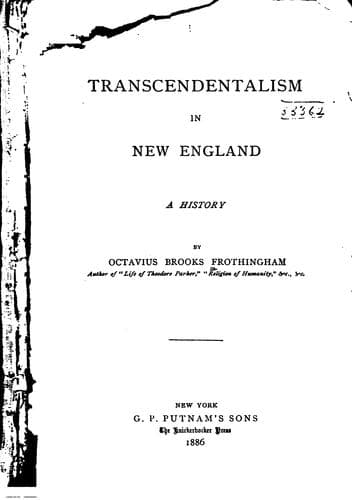
Transcendentalism in New England: A HistoryFrothingham, Octavius Brooks
Philosophy
Transcendentalism in New England: A History
Frothingham, Octavius Brooks
Transcendentalism (New England)
A contemporary and intimate friend of Johnson, a Transcendentalist
equally positive, but of more mystical type, is Samuel Longfellow. The
two are interestingly contrasted, and by contrast, blended. Between them
they collected and published a book of hymns--"Hymns of the Spirit"--to
which both contributed original pieces, remarkably rich in sentiment,
and of singular poetical merit. Johnson's were the more intellectual,
Longfellow's the more tender; Johnson's the more aspiring, Longfellow's
the more devout; Johnson's the more heroic and passionate, Longfellow's
the more mystical and reflective. Like his friend, Longfellow is quiet
and retiring--not so scholarly, not so learned, but meditative. His
sermons are lyrics; his writings are serene contemplations, not white
and cold, but glowing with interior and suppressed radiance. A recluse
and solitary he is, too, though sunny and cheerful; a thinker, but not a
dry one; of intellectual sympathies, warm and generous; of feeble
intellectual antipathies, being rather unconscious of systems that are
foreign to him than hostile to them. He enjoys his own intellectual
world so much, it is so large, rich, beautiful, and satisfying, that he
is content to stay in it, to wander up and down in it, and hold
intercourse with its inhabitants; yet he understands his own system
well, is master of its ideas, and abundantly competent to defend them,
as his essays published in the "Radical" during its short existence,
testify. He has published little; ill health has prevented his taking a
forward place among reformers and teachers; but where he has ministered,
his influence has been deep and pure. Not few are the men and women who
ascribe to him their best impulses, and owe him a debt of lasting
gratitude for the moral faith and intellectual enthusiasm he awakened in
them.
Another remarkable man, of the same school, but of still different
temper--a man who would have been greatly distinguished but for the
disabilities of sickness--is David A. Wasson. Though contemporary, he
came forward later; but when he came, it was with a power that gave
promise of the finest things. As his latent faith in the intuitive
philosophy acquired strength, he broke away from the Orthodoxy in which
he had been reared, with an impulse that carried him beyond the lines of
every organized body in Christendom, and bore him into the regions of an
intellectual faith, where he found satisfaction. He has been a diligent
writer, chiefly on Ethical and Philosophical themes, on the border land
of theology. His published pamphlets and sermons on religious questions,
even the best of them, give scarcely more than an indication of his
extraordinary powers. He is a poet too, of fine quality; not a singer of
sentimental songs, nor a spinner of elegant fancies, but a discerner of
the spirit of beauty. "All's Well," "Ideals," "The Plover," "At Sea,"
are worthy of a place in the best collections.
Public-domain text, read in full here on John Shaqi.
Reviews
Reviews
No reviews yet
Be the first to share your thoughts on this work.
Elsewhere in the archive
Join the Discussion
Join the discussion
Sign in to leave a comment or review.
Sign InorCreate an account