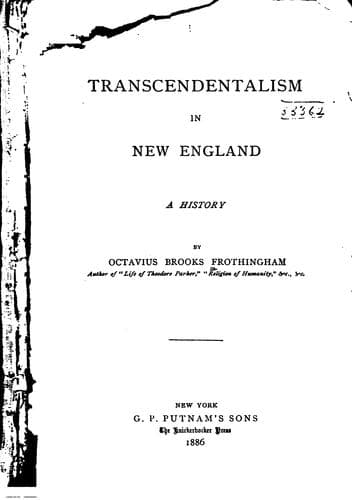
Transcendentalism in New England: A HistoryFrothingham, Octavius Brooks
Philosophy
Transcendentalism in New England: A History
Frothingham, Octavius Brooks
Transcendentalism (New England)
It has been the appointed task of Mr. Wasson to be on the alert against
assaults on the intuitive philosophy from the side of material science.
Like Transcendentalists generally, he has accepted the principles of his
philosophy on the testimony of consciousness and as self-evidencing; but
more than most, he has regarded them as essential to the maintenance of
truths of the spiritual order; and as a believer in those truths, he has
been holily jealous of the influence of men like Herbert Spencer, Mill,
Bain, and the latest school of experimental psychologists. His doctrine,
in its own essence, and as related to the objective or material system,
is closely stated in the essay on the "Nature of Religion," contained
in the volume, entitled "Freedom and Fellowship in Religion," recently
published by the Free Religious Association. It is not easily quotable,
but must be read through and attentively. Whoever will take pains to do
that, may understand, not merely what Mr. Wasson's position is, but what
fine analysis the intuitive philosophy can bring to its defence. A
volume of Mr. Wasson's prose essays and poems would be a valuable
contribution to the literature of Transcendentalism; for he is, on the
whole, the most capable critic on its side. Unfortunately for the
breadth of his fame and the reach of his power, he writes for thinkers,
and the multitude will never follow in his train.
The names of the disciples and prophets of Transcendentalism multiply as
they are told off. There is T. W. Higginson, the man of letters--whom
every body knows--a born Transcendentalist, and an enthusiastic one,
from the depth of his moral nature, the quickness of his poetic
sensibility, his love of the higher culture. His sympathies early led
him to the schools of the ideal philosophy. He edited the works of
Epictetus; speaks glowingly on the "Sympathy of Religions;" is
interested in the pacification of the sects and churches on the basis of
spiritual fellowship in truths of universal import; lectures
appreciatingly on Mohammed and Buddha; holds Spencer in light esteem by
the side of Emerson. In the controversial period--which was not ended
when he left the Divinity School--he was entirely committed to the party
of progress. Hennell's "Christian Theism" lay on his table at Divinity
Hall. He was an ally of Parker; an abolitionist; the colonel of a black
regiment in the civil war; and from the first has been a champion of
woman's claim to fulness of culture and the largest political rights. A
clear and powerful mind, that in controversy would make its mark, if
controversy were to its taste, as it is not.
Public-domain text, read in full here on John Shaqi.
Reviews
Reviews
No reviews yet
Be the first to share your thoughts on this work.
Elsewhere in the archive
Join the Discussion
Join the discussion
Sign in to leave a comment or review.
Sign InorCreate an account