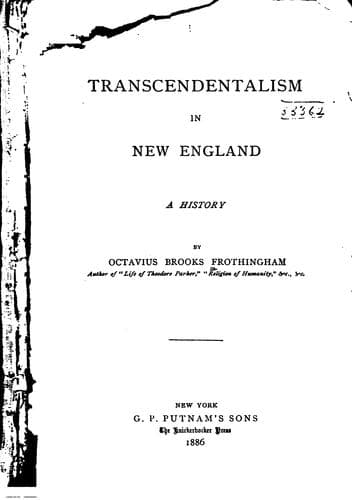
Transcendentalism in New England: A HistoryFrothingham, Octavius Brooks
Philosophy
Transcendentalism in New England: A History
Frothingham, Octavius Brooks
Transcendentalism (New England)
In these sketches of transcendental leaders--as in this study of the
transcendental movement,--few have been included but those whom the
intuitive philosophy drew away from their former church connections and
gathered into a party by themselves--a party of protestants against
literalism and formalism. The transcendental philosophy in its main
ideas, was held by eminent orthodox divines who accepted it as entirely
in accordance with the Christian scheme, and used it in fact as an
efficient support for the doctrines of the church. The most eminent
divines of New England did this, and were considered entirely orthodox
in doing it, their Christian faith gaining warmth and color from the
intuitive system. As has already been said, the Trinitarian scheme has
close affinities with Platonism. But none of these men called themselves
or were called Transcendentalists. The Transcendentalist substituted the
principles of his Philosophy and the inferences therefrom for the creed
of the church, and became a separatist. With him the soul superseded the
church; the revelations of the soul took the place of bible, creed and
priesthood. The men that have been named all did this, with the
exception of James Freeman Clarke, who adhered to the ministry and the
church. But his intimacy with the transcendental leaders, and his
cooperation with them in some of their most important works, to say
nothing of the unique position his transcendental ideas compelled him to
assume, as well in ecclesiastical matters as in social reform, entitle
him to mention. Convers Francis--parish minister at Watertown from 1819
till 1842, and Parkman, professor of Pulpit Eloquence and the Pastoral
Care at Cambridge from 1842 till 1863--though never conspicuous either
as preacher or minister, and never recognized as a representative
apostle, was influential as a believer in the spiritual philosophy,
among young men. To him Theodore Parker acknowledged his debt; to him
successive classes of divinity students owed the stimulus and direction
that carried them into the transcendental ranks; Johnson, Longfellow,
Higginson were his pupils at Cambridge, and carried thence ideas which
he had shaped if not originated. In many things conservative,
disagreeing on some points with Emerson, whom he revered and loved as a
man, regretting much that seemed sarcastic, arrogant, derisive in
Parker's "Discourse of Religion," he gave his full assent to the
principles of the intuitive philosophy, and used them as the pillars of
Christianity. Had he been as electric and penetrating as he was truthful
and obedient, high-minded and sincere, hearty and simple, he would have
been a force as well as an influence. In 1836 he foresaw the rupture
between "the Old or English school belonging to the sensual and empiric
philosophy,--and the New or German school, belonging to the spiritual
philosophy," and gave all his sympathy to the latter as having the most
of truth.
Public-domain text, read in full here on John Shaqi.
Reviews
Reviews
No reviews yet
Be the first to share your thoughts on this work.
Elsewhere in the archive
Join the Discussion
Join the discussion
Sign in to leave a comment or review.
Sign InorCreate an account