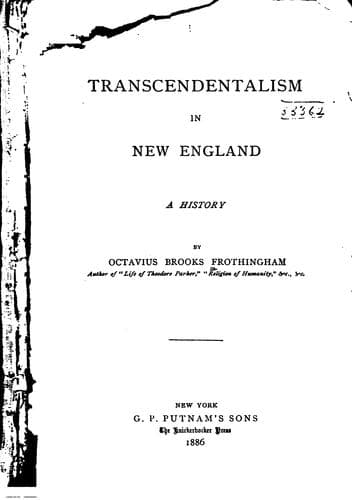
Transcendentalism in New England: A HistoryFrothingham, Octavius Brooks
Philosophy
Transcendentalism in New England: A History
Frothingham, Octavius Brooks
Transcendentalism (New England)
He was the senior member of the "Transcendental Club,"
composed of the liberal thinkers who met to discuss literary and
spiritual subjects on the ground of reason and the soul's intuitive
perceptions. With deep interest he followed the course of speculative
and practical reform to the close of his life. Some, of whom he was not
one, engaged in the discussions for a little while, attended the
meetings, and set forth bold opinions, but retired within their close
fellowships as soon as plans for propagandism or schemes of organization
were proposed. Their sympathies were literary and within the recognized
limits of literature; but they had either too little courage of
conviction, or too little conviction, to depart from accustomed ways or
break with existing associations. The number of professed
transcendentalists in the restricted sense, was never large, and, after
the first excitement, did not greatly increase. There was but one
generation of them. The genuine transcendentalists became so in their
youth, ripened into full conviction in middle life, and, as a rule,
continued so to old age. The desertions from the faith were not many.
Half a dozen perhaps became catholics; as many became episcopalians; but
by far the greater part maintained their principles and remained serene
dissenters, "in the world, but not of it."
Transcendentalism was an episode in the intellectual life of New
England; an enthusiasm, a wave of sentiment, a breath of mind that
caught up such as were prepared to receive it, elated them, transported
them, and passed on,--no man knowing whither it went. Its influence on
thought and life was immediate and powerful. Religion felt it,
literature, laws, institutions. To the social agitations of forty years
ago it was invaluable as an inspiration. The various reforms owed
everything to it. New England character received from it an impetus that
never will be spent. It made young men see visions and old men dream
dreams. There were mounts of Transfiguration in those days, upon which
multitudes thought they communed visibly with lawgivers and prophets.
They could not stay there always, but the memory will never cease to be
glorious. Transcendentalism as a special phase of thought and feeling
was of necessity transient--having done its work it terminated its
existence. But it did its work, and its work was glorious. Even its
failures were necessary as showing what could not be accomplished, and
its extravagances as defining the boundaries of wise experiment. Its
successes amply redeemed them all, and would have redeemed them had they
been more glaring and grotesque. Had it bequeathed nothing more than the
literature that sprung from it, and the lives of the men and women who
had their intellectual roots in it, it would have conferred a lasting
benefit on America.
XV.
LITERATURE.
Public-domain text, read in full here on John Shaqi.
Reviews
Reviews
No reviews yet
Be the first to share your thoughts on this work.
Elsewhere in the archive
Join the Discussion
Join the discussion
Sign in to leave a comment or review.
Sign InorCreate an account