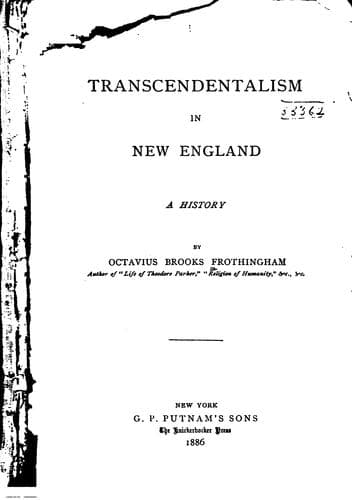
Transcendentalism in New England: A HistoryFrothingham, Octavius Brooks
Philosophy
Transcendentalism in New England: A History
Frothingham, Octavius Brooks
Transcendentalism (New England)
But still it may be asked, why did Jesus make expressions so
extraordinary and emphatic as these--"This is my body which is broken
for you. Take; eat. This is my blood which is shed for you. Drink
it."--I reply they are not extraordinary expressions from him. They were
familiar in his mouth. He always taught by parables and symbols. It was
the national way of teaching and was largely used by him. Remember the
readiness which he always showed to spiritualize every occurrence. He
stooped and wrote on the sand. He admonished his disciples respecting
the leaven of the Pharisees. He instructed the woman of Samaria
respecting living water. He permitted himself to be anointed, declaring
that it was for his interment. He washed the feet of his disciples.
These are admitted to be symbolical actions and expressions. Here, in
like manner, he calls the bread his body, and bids the disciples eat. He
had used the same expression repeatedly before. The reason why St. John
does not repeat his words on this occasion, seems to be that he had
reported a similar discourse of Jesus to the people of Capernaum more at
length already (John VI. 27). He there tells the Jews, "Except ye eat
the flesh of the Son of Man and drink His blood, ye have no life in
you." And when the Jews on that occasion complained that they did not
comprehend what he meant, he added for their better understanding, and
as if for our understanding, that we might not think his body was to be
actually eaten, that he only meant, _we should live by his commandment_.
He closed his discourse with these explanatory expressions: "The flesh
profiteth nothing; the _words_ that I speak to you, they are spirit and
they are life."
Public-domain text, read in full here on John Shaqi.
Reviews
Reviews
No reviews yet
Be the first to share your thoughts on this work.
Elsewhere in the archive